Saturday, 13 December 2008

Did Obama or Rahm Emanuel discuss the Senate seat with Blagojevich?

I guess the world knows by now that Governor Blagojevich of Illinois is under investigation for allegedly trying to sell the Senate seat being vacated by President-elect Barack Obama.

From the Chicago Tribune, December 13th:

"Obama said Thursday he had never spoken to Blagojevich about the Senate vacancy and was "confident that no representatives" of his had engaged in any dealmaking over the seat with the governor or his team. He also pledged Thursday that in the "next few days" he would explain what contacts his staff may have had with the governor's office about the Senate vacancy.

Emanuel, who has long been close to both Blagojevich and Obama, has refused to respond to questions about any involvement he may have had with the Blagojevich camp over the Senate pick. A spokeswoman for Emanuel also declined to comment Friday."


However,

"One source confirmed that communications between Emanuel and the Blagojevich administration were captured on court-approved wiretaps."

Chicago Tribune 13/12/08

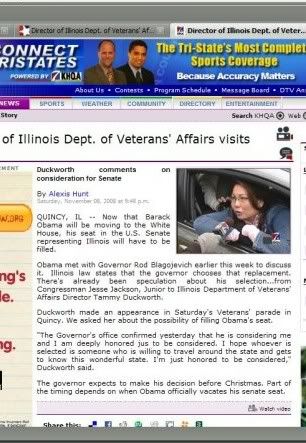
So, there are apparently tapes from wiretaps confirming that Emanuel discussed the Senate seat with Blagojevich. What of Obama? Well, I have come across two cached web pages today, which are said to have disappeared, but which someone took a screenshot of and which I reproduce here. One is an article from the KHQA (Tri-States news web site.) about a planned meeting between Obama and Blagojevich to discuss the issue. This is dated November 5th 2008.
The third paragraph reads, "He's meeting with Governor Rod Blagojevich in Chicago this afternoon to discuss it."

Planned

The next screenshot is an article which states that the proposed meeting took place.

Large cropped


I have had to make the second screenshot extra-large so that it can be read! It is dated November 8th and states that, "Now that Barack Obama will be moving to the White House, his seat in the US Senate representing Illinois will have to be filled. Obama met with Governor Rod Blagojevich earlier this week to discuss it."

So, did he or didn't he? Did Barack Obama, in spite of denials, meet with Governor Rod Blagojevich to discuss the Senate seat? And why have these pages been 'disappeared' from the KHQA web site and even the cached pages have now gone?

There could be some very interesting developments here.

Friday, 12 December 2008

Maryland State Police: Spying on pacifists, environmentalists and nuns.

LA Times

By Bob Drogin
December 7, 2008
Reporting from Takoma Park, Md. -- To friends in the protest movement, Lucy was an eager 20-something who attended their events and sent encouraging e-mails to support their causes.

Only one thing seemed strange.

"At one demonstration, I remember her showing up with a laptop computer and typing away," said Mike Stark, who helped lead the anti-death-penalty march in Baltimore that day. "We all thought that was odd."

Not really. The woman was an undercover Maryland State Police trooper who between 2005 and 2007 infiltrated more than two dozen rallies and meetings of nonviolent groups.

Maryland officials now concede that, based on information gathered by "Lucy" and others, state police wrongly listed at least 53 Americans as terrorists in a criminal intelligence database -- and shared some information about them with half a dozen state and federal agencies, including the National Security Agency.

Among those labeled as terrorists: two Catholic nuns, a former Democratic congressional candidate, a lifelong pacifist and a registered lobbyist. One suspect's file warned that she was "involved in puppet making and allows anarchists to utilize her property for meetings."

"There wasn't a scintilla of illegal activity" going on, said David Rocah, an attorney for the American Civil Liberties Union, which filed a lawsuit and in July obtained the first surveillance files. State police have released other heavily redacted documents.

Investigators, the files show, targeted groups that advocated against abortion, global warming, nuclear arms, military recruiting in high schools and biodefense research, among other issues.

"It was unconscionable conduct," said Democratic state Sen. Brian Frosh, who is backing legislation to ban similar spying in Maryland unless the police superintendent can document a "reasonable, articulable suspicion" of criminal activity.

The case is the latest to emerge since the Sept. 11 attacks spurred a sharp increase in state and federal surveillance of Americans. Critics say such investigations violate constitutional guarantees of freedom of speech and assembly, and serve to inhibit lawful dissent.

In the largest known effort, the Pentagon monitored at least 186 lawful protests and meetings -- including church services and silent vigils -- in California and other states.

The military also compiled more than 2,800 reports on Americans in a database of supposed terrorist threats. That program, known as TALON, was ordered closed in 2007 after it was exposed in news reports.

The Maryland operation also has ended, but critics still question why police spent hundreds of hours spying on Quakers and other peace groups in a state that reported more than 36,000 violent crimes last year.

Stephen Sachs, a former state attorney general, investigated the scandal for Gov. Martin O'Malley -- a Democrat elected in 2006. He concluded that state police had violated federal regulations and "significantly overreached."

According to Sachs' 93-page report and other documents, state police launched the operation in March 2005 out of concern that the planned execution of a convicted murderer might lead to violent protests.

They sent Lucy to join local activists at Takoma Park's Electrik Maid, a funky community center popular with punk rockers and slam poets. Ten people attended the gathering, including a local representative from Amnesty International.

"The meeting was primarily concerned with getting people to put up fliers and getting information out to local businesses and churches about the upcoming events," the undercover officer reported later. "No other pertinent intelligence information was obtained."

That proved true for all 29 meetings, rallies and protests that Lucy ultimately attended. Most drew only a handful of people, and none involved illegal or disruptive actions.

Using the aliases Lucy Shoup and Lucy McDonald, she befriended activists. "I want to get involved in different causes," she wrote in an e-mail, citing her interest in "anti-death penalty, antiwar and pro-animal actions!!!"

Max Obuszewski, a Baltimore pacifist who leads antiwar protests, said Lucy asked about civil disobedience, but didn't instigate any. "She never volunteered to do anything, not even hand out leaflets," he said. "She was not an agent provocateur."

Updated 12/12/08 - SOS Madeleine McCann 6/12/08 - the Tapas 7 interviews in the UK - Volume 1


http://sosmaddie.dhblogs.be/

All seven Britons were interviewed in early 2008, before the Portuguese investigation was put on hold for lack of impartial and brave justice.

In the interests of the public, remembering that justice is always the conquest of civilisation over violence, of appeasement over endless revenge, of stability over chaos, the conversations (yes, it was more like conversations than real interviews) were recorded on video and the transcriptions will be available for download, only in English, at the end of each article. The videos will be opportunely disclosed.

Jane Tanner: selective memory, contradictions and other things....

After 11 months of the investigation, in spite of all that could have been said or done about the disappearance of Madeleine McCann, Jane Tanner, one of the Tapas 9, admitted to officer Ferguson of the Leicestershire police that she was mistaken about the arrangement in which the group were seated at the table. An apparently minor detail, but which is now more revealing: "Russell said he was sitting between Rachael and Diane. So, I think, I had Diane there, Russell was there. And I think Dave, I think that Dave could have been there and Fiona there."

Jane Tanner's interview, in April 2008, was recorded on video, to which I have had access and which will be disclosed at the right time in a documentary about Maddie's disappearance.

According to the new seating plan, Jane was sitting "in an anti-clockwise direction," next to Kate, followed by Matthew, Fiona, David Payne, Gerry McCann, Dianne, Russell and finally Rachael.

According to Jane Tanner, in her interview with the British police, Kate McCann was more anxious than usual during dinner on May 3rd 2007, the night of Madeleine's disappearance: "There is something I haven't mentioned (...) she had said that Madeleine had said something strange about where were you last night when I woke up.
And as I said, I can't remember at what point in the meal she said that (...) I think she said "when Sean and me woke up," I can't remember if it wasn't when two of them woke up."

"I wondered, if there wasn't another reason, you know, why the checks were more frequent," Jane Tanner then stressed, indicating that Kate was wondering if Maddie might wake up.

Questioned about the length of time that Gerry was absent from the dinner table, Jane explains: "that would have been at least five minutes, if not more, because, I wonder, because he had left before I actually left there were conversations about whether he had stopped on the way. So, I mean, if, I think it must have been something like five or ten minutes, five or ten minutes after he had left. I can't say for sure though."

"(...) I went back up the road and I can't remember exactly, I know this, I know, I think that Gerry thinks he was in a different place from where I think he was standing, but I was quite sure, as I walked back up the road, they were standing, one of them was on the road and the other was just on the edge of the pavement, but I thought that it was at the side of the road where I was walking, but I know that Gerry thinks they were on the other side. But I think they were closer, because as I passed, I nearly went to greet them in some way and I thought at that moment Oh "they're chatting chatting chatting" and I thought, you know, I didn't, I didn't know if they had seen me or not, but I actually went to greet them and I think if they had been so far away I don't know if I would somehow have almost gone to say hello to them," states Jane Tanner admitting that she and Gerry don't agree about where they found themselves.

"I thought that they were, when you go up here, I thought they were more, euh, once again I know that this is where me and Gerry disagree, but I thought they were kind of closer to the alleyway. I think kind of (...) I think that one of them was on the road and I think, I thought that it was Jez on the road because he had the pram. And towards, I don't know, I can't remember in which direction he was facing. No, I mean, I think I remember that in my statement I said it, but I can't remember now in which direction he was facing.

"And I thought that Gerry was almost on the edge of the pavement or just, just kind of on the road, but certainly kind of alongside it, kind of closer to that alleyway. I don't think they were near the apartment gate, I thought they were kind of a bit further down, further down the road than that," Jane admits to the police, demonstrating - according to one of the British investigators, a quite strange memory.

"Madame Tanner gave a witness statement before the television cameras, she was interviewed by our Portuguese colleagues...now she is incapable of remembering most of the details - the Leicestershire police, however, got her to read her previous statements -, but curiously, she happens to clarify certain key points that agree with the story recounted by the other members of this group," states an officer from the British police after having viewed the videos of the interviews.



The Tanner

This British police officer, who no longer has contact with this case, is meanwhile one of the direct witnesses of the most important moments in the investigation by the Portuguese authorities. Bitter and deeply disappointed with the behaviour of the British government in this case, the man, from a legal point of view, no longer has the right to speak about Madeleine McCann's disappearance. A ban which he has not respected for reasons "of professionalism and moral conscience" in spite of the heavy consequences to come.

"Oh, it's someone taking their child to bed."

Jane Tanner Suspects 235 web.jpgJane Tanner, one of the key witnesses, whom the McCanns have not left much space for manoeuvre, explains once again the layout of the premises and her movements: according to her witness statement, going out through the door of the Tapas Bar, she walked up the hill, passed by Gerry and Jez who were on her right.


"(...) Right, yeah, So, I went past them, um, going up the hill, and then getting to the top of the road, as I arrived at the top, this person, someone crossed the top of the road with a child. And obviously at that time - I just thought 'oh it's somebody taking his child to bed,' as they say. "

"I think it was starting to get dark (...) there wasn't, apart from Gerry and Jez, there wasn't anyone else. (...) I really saw no one at all. I said, I think, that this made me think that it was even more strange, I think that when I had gone to check on other evenings at that time I probably didn't see anyone at all, it was earlier that you would see people here and there, carrying their children," Jane Tanner said, confirming that it all happened, " roughly, around ten past nine."


"(....) I was kind of jogging along, because obviously I was trying to do the check and get back as quickly as possible too, so I just thought 'Oh I'm just going to do the check as quickly as possible.."
In answer to officer Fergusson, Tanner states that her intention was just to "check on Ella and Evie," because no one else had done it: "Gerry was there, so I thought he had just checked (his children). Matt had checked when he had, um, been (...). And we never checked Dave and Fi because they had their monitor, which they were quite happy with, so they didn't check at all, like that."


"Oh, a poor parent like us..."

Tanner876876.jpg

"(...) just as I got to the top, someone crossed over. And the thing that really hit me was, um, the bare feet. And the thought that came to mind was, I was saying, that when we were in Leicester (...) we had the habit of walking to David and Fi's house for, um, the children, for dinner with the children, the children would play, we put them into travel cots there and we would sometimes stay a bit late and then carry the children to the house (...) We wrap them in a blanket or something, but their feet always stick out, and you think 'Oh, they're going to get cold feet' because they would always wriggle about. So, one thing I thought was 'Oh, a poor parent like us, you know, that child is obviously being taken home (...)

(...) That was the only reason that I looked at him really, I think. Because at that moment I thought it's somebody picking their child up from the crèche or, you know, just a father carrying his own child..."

Questioned by the officer, Tanner explains that the route followed by the suspect she claims to have seen doesn't match with the idea of someone fetching his child from the crèche: (...) In fact I thought 'Oh, a bit odd,' but not in a million years would I have thought 'It's Madeleine.' (...) And well, yeah, if I had though, yeah, you know, if I had seen that it was Madeleine you would have, you know, I wasn't going to go 'Oh there's Madeleine,' you know, I would have shouted, but. But, yeah, I know that the police think I am an interested witness and whatever, but I don't know what I can do about it.

After a brief moment of emotion - visible only on the video recording - Jane Tanner continues: "No, but the best thing that could happen for me, apart from Madeleine being found, it's somebody coming forward and saying 'It was me,' you know, 'It was me going along there', because, you know, you know, I don't want it to be Madeleine, but you know, there's none, but I am convinced that it was and, you know, people have to, so I don't know what I can do to make them believe it. I'm sorry."

"(...) I really want to assure myself that I am believed, because I haven't lied here. I don't really do that and I just think it's important..."

According to her own witness statement, Jane Tanner noted three details about the man whom she claims to have noticed crossing over the road with the child in his arms, amongst those his feet, because "he wasn't running, but walking at a steady pace."

The man - Jane Tanner explains to the British police officer - was walking along the pavement on the same side where she was.

"(...) I think I'd just prefer to stick to what I said in my original statement, in terms of, because even, I mean, this goes back to the sketch, even when I did the sketch, before that, you know, things were, were unclear. I needed to do that sketch.

According to Jane Tanner, the man had long hair, quite dark and shiny. He was wearing dark clothes, "not big, but quite baggy."

"Dark colours, but then again it was, I think that it was quite dark, so dark, kind of a dark sort of jacket, but on the other hand, lighter trousers in a horrible colour, again this is, kind of a dark yellowish-brown, horrible, but not, not a good colour for trousers, but on the other hand, I wonder if it was the light that made them appear, made them appear more of a sort of mustard. It wasn't a mustard because it was too light, but it was just like one, as I said they weren't attractive. They weren't the kind of clothes I would expect of someone on holiday at Mark Warner. They were, I can't think of the material. I tried to describe it before, but as some sort of cottony material, but baggy," Tanner states.

If Jane Tanner admits a few inconsistencies in the description of the man she swears having seen on the night of Madeleine McCann's disappearance, admitting notably that she "wasn't totally in agreement" with several details of the latest identikit image, such as the length of hair.

"(...) I tried to do it, though, from my original description which we noted (...) we tried to write down all our thoughts and I tried to do it as much as I could from that..."

The individual's height is also challenged by Jane Tanner because, according to her, there was allegedly an error in translation, which did not seem to surprise the Leicestershire police officer, but which was strongly contested by several Portuguese and British police officers who participated in the investigation: all the translations were done or checked later by properly accredited professional translators, which does not leave the least doubt about the quality of their work.

"(...) But I think that was confused in the translation because I don't know what it was in metres and they, kind of, converted that into metres from my statement (...) But I think that it was kind of in the region of five feet nine, five feet ten.."

Questioned about the build of the man she allegedly saw, Tanner explains that it was "Medium, but just rather a normal build. As I said, I think the clothes were quite baggy, so I think they made him look bigger than he probably was, though. And also, he was, his shoulders were poking out, you know, kind of. So, I think, umm, yeah, roughly medium, a roughly medium build.

To be continued.

(Jane Tanner's statements in English can be downloaded from the SOS Madeleine McCann web site, in pdf format. To date - 12/12/08 - there are five downloads available.)

Wednesday, 10 December 2008

The Abduction Alert plan allowed a newborn to be recovered.

http://sosmaddie.dhblogs.be/

2713808pkmlh_226.jpg

It is thanks to the launching, on Tuesday evening, of the Abduction alert plan that a newborn, abducted the day before from a maternity unit in Orthez, was found today by the French gendarmerie at the home of the woman who had taken him from his cot while the mother was having a shower.

The little boy, born two days before, was found this morning 'in good health' at the home of the woman who had abducted him, in Billère, Pau. She was arrested and placed under the provision of the law which, according to the words of Erick Maurel, Prosecutor of the Republic, "will be capable of understanding a moment of confusion, a moment of personal difficulty and what will be strongly appreciated is that the child is returned to the mother."

According to a source from the gendarmerie, it was the brother of the 48 year-old woman, a long-distance driver from the Jura region, who called the Jura gendarmes, who forwarded the call to their colleagues in Pau, after having received a telephone call from his sister telling him that she had given birth, which seemed eminently suspicious to him.

The woman matched the description given by witnesses and transmitted by the Abduction Alert system: "A woman in her forties, overweight, tall, wearing a black coat." The arrest "took place in a reasonable manner, there were no problems" and little Diango returned to his mother's arms after routine medical examinations.

Rachida Dati, who recently defended the creation of an Abduction Alert system in all European countries, as the European authorities have been proposing for several years, wished to congratulate the Pau Prosecutor of the Republic who took the initiative to launch the Abduction Alert plan, a plan which "has just proved once again it's effectiveness."

Enfants Kidnappés

According to the account from the gendarmes, the little boy was found thanks to the telephone call from a man indicating that his sister had told him she had just given birth while, to his knowledge, she was not pregnant.

"Having seen the abduction alert, this gentleman made the connection and called the circulated telephone number to report that course of events in case it was linked to this case." Bertrand Ponty, commander of the Aquitaine Gendarmerie told Reuters. In late morning, the investigators went to this woman's home, in Billère in the Pau region (Pyrénées-Atlantiques) where they found the baby who was taken into their care. The woman, who was alone in the apartment, was remanded in custody, he stated.

One hundred and fifty gendarmes were involved in the search.


Two day-old baby abducted on Tuesday in Orthez has been found

According to a Belgian daily newspaper's online edition, little Diango, who was abducted on Tuesday from a maternity unit in Orthez (Pyrénées-Atlantiques) has been found safe and well. He was apparently recovered by police checking vehicles and the woman who abducted him has been arrested.

"Le bébé de deux jours enlevé tôt mardi dans une maternité d'Orthez (Pyrénées-Atlantiques) a été retrouvé "en bonne santé" et la femme qui l'avait enlevé a été interpellée, a-t-on appris mercredi de source policière."


Le Soir

The woman who abducted the child has been arrested, thanks to witnesses who gave a description and the woman's brother, who called the police after seeing the alert. He had received a call from his sister saying that she had given birth, which seemed immediately suspicious to him, since she had not appeared to be pregnant, and her brother matched her to the description given by the witnesses.

Another success for the French Abduction Alert system.

Congratulations to the gendarmes who found little Diango and all those French people who took part in the alert and the search.

Alerte enlèvement - Abduction alert - 2 day-old baby taken from maternity unit in Orthez (Pyrénées-Atlantiques)


Enfants Kidnappés

9/12/08

Un bébé de deux jours enlevé dans une maternité des Pyrénées-Atlantiques.


Un bébé de 2 jours a disparu mardi de la maternité d'Orthez (Pyrénées-Atlantiques) et le plan "Alerte enlèvement" a été déclenché peu après, selon le procureur de la République de Pau.

La mère du bébé, un petit garçon prénommé Diango, a constaté vers 16H30 sa disparition dans sa chambre en sortant de la salle de bains où elle était occupée à prendre sa douche. "La personne en a profité à ce moment-là", a souligné le commandant Ponty, chargé de la communication de la gendarmerie d'Aquitaine.

La maman, âgée de 31 ans, est originaire de Biarritz. Le nourrisson était vêtu d'une grenouillère orange et verte.

Des témoins auraient vu une femme "de type européen, âgée de quarante à cinquante ans" vêtue d'un manteau noir, emmener le bébé, a indiqué à l'AFP le procureur Erick Maurel.

"Les recherches se font tous azimuts", a précisé le procureur. "La maman est en état de choc", a-t-il ajouté, évoquant une famille sans histoires. L'alerte a été donnée vers 17H30 à la gendarmerie d'Orthez qui a été chargée de l'enquête, selon le parquet.

Le plan Alerte enlèvement, un dispositif d'alerte massive et immédiate pour rechercher un enfant enlevé, a été déclenché peu après 20H00.

Adopté en France en février 2006, ce plan consiste à lancer à la radio, à la télévision et sur les panneaux des gares et autoroutes, une alerte massive pour mobiliser la population à la recherche d'un enfant enlevé et de son ravisseur présumé.

Le message d'alerte précise que la suspecte est une femme "de grande taille et corpulente de type européen, cheveux courts foncés, vêtue d'un manteau noir". "Si vous localisez l'enfant ou la suspecte, n'intervenez pas vous-même mais appelez la gendarmerie au numéro 0800 36 32 68 ou 0800ENFANT", ajoute le message.

Dès l'alerte donnée par la mère, la gendarmerie a mis en place un dispositif de recherche dans l'enceinte de l'hôpital, à proximité de l'établissement et à la gare d'Orthez. Simultanément, des patrouilles avec contrôles d'identité ont été organisées à toutes les sorties de la ville.

Un plan Epervier a également été mis en place sur le département des Pyrénées-Atlantiques, puis étendu aux départements voisins ainsi qu'aux postes frontières, selon la gendarmerie.

Une quarantaine d'enquêteurs s'occupent de l'audition des témoins et une centaine de gendarmes ont été déployés sur le terrain.

Enfants Kidnappés 9/12/08

Posted in French from EK for the moment. English translation later.

Monday, 8 December 2008

Enfants Kidnappés - Jane Tanner: an imitation of an interview.


Enfants Kidnappés

The Jane Tanner rogatory interview is also being published, in French, on the Enfants Kidnappés web site. This is the introduction to the first part:


Taped interview.


The events took place at the beginning of April 2008. Each member of the group known as the "Tapas 7" was interviewed by the British authorities. The request was made, as I am sure you remember, by the Portuguese authorities.


The purpose of their new interviews was to update the inconsistencies and above all to see the changes from each member in comparison with their previous statements. This is important, because from the PJ's point of view one or several members of the group were lying in their statements. We are in the middle of an investigation concerning the disappearance or abduction or killing (murder or not) of a little innocent four year-old girl: Madeleine.


To this end, it is totally inconceivable to allow witnesses, who could at any time become suspects, to read, even only to skim through, their previous statements. It was like this, however, that their mock interviews took place, to the detriment of the most fundamental code of ethics, trampling underfoot the search for the truth. Poor Madeleine.


(The first part of Jane Tanner's statement, up to the point where the fire alarm went off, is available here: Enfants Kidnappés)

Friday, 5 December 2008

The case of Grégory Villemin, disappeared October 16th 1984


From the blog of Georges Moréas.

http://moreas.blog.lemonde.fr/

3/12/08

On October 16th 1984, Grégory Villemin, aged four and a half, disappeared from his parents' house in Lépanges-sur-Vologne, in the Vosges. In the evening, his body was found in the waters of the Vologne, in Docelles, six kilometres from his home. His legs and arms were bound by a rope and he had drowned. No trace of violence on the little body

On the evidence, he had been thrown into the river alive - as a cat would be drowned. Suspicion fell on the family. The next day, the child's father, Jean-Marie Villemin, received an anonymous letter: "(...) Your money could not give you back your son. This is my revenge, poor con...."

Two weeks later, the Epinal judge, Jean-Michel Lambert, issued a warrant against Bernard Laroche, a cousin of the Villemins, who was the object of a denunciation by his own cousin, aged 15. What a family! In February 1985, the judge freed him, and one month later the Villemin father shot him with a shotgun. But the rumours took off. They accused Christine Villemin, little Grégory's mother. In highbrow ramblings, Marguerite Duras hammers home the point. Convinced of her guilt, she wrote in Libération that that it was a "sublime, inevitably sublime," crime.

For a long time, the PJ were kept out of this case. Would their investigators have done better than the gendarmes? Commissioner Jacques Corrazi, who later took over the case, was probably convinced of it. He might have managed to curb the delirium of a low-ranking judge whose peers said it was a "mental tightrope." Christine Villemin was subsequently placed under investigation for the murder of her son. On February 3rd 1993, the Dijon criminal court concluded that there was no case against her, and the case was dismissed. Little Grégory's killer has never been found.

Unless...

Twenty-four years later, can forensic science succeed where the gendarmes, the police and the courts have failed? In deciding to re-open the investigation, the Dijon Court of Appeal must consider that the sealed items, which have apparently been carefully preserved (clothing, bonds, poison-pen letters...) could now bring valuable evidence, notably thanks to DNA traces.

This is, I believe, a first in France. Which renews our interest in the genetics file. *

Note: is this what M. Moréas is referring to above? Le FNAEG (fichier national automatisé des empreintes génétiques)

Le + et le du fichier


Monday, 1 December 2008

Dr Ron Polarik on Barack Obama's birth certificate.

This is an analysis of the birth certificate said to prove that Barack Obama was born in Hawaii and is therefore a natural born citizen of the United States. Barack Obama has been asked by quite a few citizens to produce his full certificate.

Mr Obama, you promised transparency. So, show us your birth certificate!

Sunday, 30 November 2008

Mr. Obama: Don’t Miss Next Week’s Chicago Tribune

Canada Free Press

30/11/08

From the Canada Free Press today, Sunday November 30th 2008.

-We The People Foundation


D.C. National Press Club Event: Dec 8th

Our full-page Open Letter to Mr. Obama will be published in the Chicago Tribune on both Monday, December 1, 2008 and Wednesday, December 3, 2008. It will appear in the main news section. Click here to view a copy of the final ad.

Chicago is Mr. Obama’s hometown. His transition team is operating out of the Kluczynski Federal Building in downtown Chicago. He is known to be a regular reader of the Tribune, Chicago’s principal newspaper, with a daily circulation of over a half-million readers.

The Open Letter to Mr. Obama is a formal Petition for a Redress (Remedy) for the alleged violation of the “natural born citizen” clause of the Constitution of the United States of America.

Mr. Obama is respectfully requested to direct the Hawaiian officials to provide access to his original birth certificate on December 5-7 by our team of forensic scientists, and to provide additional documentary evidence establishing his citizenship status prior to our Washington, D.C. press conference on December 8.

A First Amendment Petition to any official of the Government for Redress of a violation of the Constitution is substantially different from the garden-variety political petitions frequently received by government officials. This Petition demands it be given the highest priority for an expedited review and official Response by Mr. Obama.

As a formal “Notice of a Constitutional Violation,” the Petition naturally includes the People’s inherent Right to an official Response. As a time-sensitive, election related Petition involving the Office of the President, failure to Respond as requested would constitute an egregious breach of the public trust and confirm the certainty of a Constitutional crisis.

For the D.C. press conference the WTP Foundation has reserved the Edward R. Murrow Room at the National Press Club from 1-4 pm on Monday, December 8, 2008. We are hopeful that C-SPAN may cover what could be a pivotal, historic event.

The Petition for Redress/Open Letter to Mr. Obama is also expected to have a significant impact on the deliberations of the Electoral College as it proceeds toward selection of the U.S. President as provided for by the Constitution.

Many, many thanks to the many individuals who donated the money needed to cover the costs of publishing the Open Letter and conducting the Washington press conference.

We are now in the process of selecting the forensic scientists who would travel to Hawaii to examine Mr. Obama’s original birth certificate (assuming he responds to the Petition for Redress by directing the Hawaiian officials to provide access to the birth certificate). The budget for this task is currently estimated at $20,000. We need to raise the money quickly. Unfortunately, we are starting from zero and we have but one week before the scientists would need to be in Hawaii.

Canada Free Press: 30/11/08


Abduction Alert adopted by the EU.

http://sosmaddie.dhblogs.be/

29/11/08

The European Union Justice Ministers, meeting yesterday in Brussels, analysed and adopted the conclusions from the simulation exercises organised by France with other member States.

The document, prepared by French Presidency of the EU, invites the member States to set up and develop national systems for alerting the public in cases of criminal abduction of children, according to the tested model, which is based on the experience of the Parisian authorities who have obtained convincing results.

According to the conclusions of the "Abduction Alert," exercises, the member States are once again called upon to describe methods for implementation, allowing the cross-border launching of national operations. For the setting up of and the development of these operations, the member States must draw inspiration from good practice established by the European Commission.

The Portuguese "Abduction Alert" system follows the French model.

In Portugal, according to the Justice Minister, Alberto Costa, the "Abduction Alert" system - following the French example - will be put in place before the end of the year. The Portuguese version of the rapid child abduction alert system provides for close collaboration with the neighbouring Spanish authorities .

If the creation of a European alert sytem had already been a work in progress for European institutions for several years, during the Portuguese Presidency, from January to July 2008, the matter became one of the Portuguese government's priorities, which the French Presidency, with Rachida Dati took forward.

According to the Portuguese minister, Alberto Costa, the Portuguese abduction alert system brings about better collaboration between the Public Minister, the PJ, every sort of media and other instruments of mass communication.

The Portuguese rapid alert system against child kidnapping, whose setting up has been allocated to the Deputy National Director of the PJ, Pedro du Carmo, will be a system which in having internal application, will be compatible with other systems already existing, or to be available, in the EU.

"The McCann couple did a public relations exercise in trying to appropriate an already ongoing initiative. (Of the Parliament.)"

The accusation was made by the deputy, Carlos Coelho, a member of the Christian Democrats group at the European Parliament and party colleague of President Barroso. The Eurodeputy knows what he's talking about, because he was amongst the 54 deputies who had adopted, in committee, the European strategy on the subject of childrens rights, a document approved in January 2008 after several years of work.

(Video of Carlos Coelho, speaking on this subject, is available on the SOS Madeleine McCann web site.)

Saturday, 29 November 2008

Did a Criminal Mastermind Stage the Mumbai Nightmare?

Alternet 28/11/08

By Yoichi Shimatsu, New America Media. Posted November 28, 2008.

The Mumbai attacks carry the signature of Ibrahim Dawood, a Indian living in Pakistan and former crime boss turned self-styled avenger.

The coordinated nighttime assault against seven major targets in Mumbai is reminiscent of the 1993 bombings that devastated the Bombay Stock Exchange. The recent attack bears the fingerprints of the same criminal mastermind – meticulous preparation, ruthless execution and the absence of claims or demands.

The eerie silence that accompanied the blasts are the very signature of Ibrahim Dawood, now a multi-millionaire owner of a construction company in Karachi, Pakistan. His is hardly a household name around the world like Osama bin Laden. Across South Asia, however, Dawood is held in awe and, in a twist on morals, admired for his belated conversion from crime boss to self-styled avenger.

His rise to the highest rungs of India's underworld began from the most unlikely position as the diligent son of a police constable in the populous commercial capital then known as Bombay.

His childhood familiarity with police routine and inner workings of the justice system gave the ambitious teenager an unmatched ability to outwit the authorities with evermore clever criminal designs. Among the unschooled ranks of Bombay gangland, Ibrahim emerged as the coherent leader of a multi-religious mafia, not just due to his ability to organize extortion campaigns and meet payrolls, but also because of his merciless extermination of rivals.

Dawood, always the professional problem-solver, gained the friendship of aspiring officers in India's intelligence service known as Research and Analysis Wing (RAW). He soon attracted the attention of American secret agents, then supporting the Islamic mujahideen in their battle against the Soviet occupiers of Afghanistan. Dawood personally assisted many a U.S. deep-cover operation funneling money to Afghan rebels via American-operated casinos in Kathmandu, Nepal.

Eager to please all comers, Dawood occasionally got his wires crossed, providing travel documents and other amenities to Islamist airplane hijackers. In response, Washington spymasters tried to unofficially "impound" his investment in the Nepalese casinos. Dawood's fury is legendary among locals. An honorable businessman, he held to the strict belief that a deal is a deal and there can be no reneging for any reason.

As Bombay moved into the league of Asia's premier cities – hotel rates and apartment rentals are the highest in the region – Dawood could have led a comfortable life as top dog. Instead he suffered a spasm of conscience, a newfound moral outrage, when rightwing Hindu nationalists destroyed a mosque in northern India in 1992, slaying 2000 Muslim worshippers, mostly women and children.

One a day in the following May, his henchmen set off bombs across Bombay, killing more than 300 people. His personal convictions had – uncharacteristically - overcome his dispassionate business ethics. Reeling in shock, his top lieutenant, a Hindu, attempted to assassinate Dawood. A bloody intra-gang war followed, but as always Dawood triumphed, even while away in exile in Dubai and Karachi.

In the ensuing decade, at the height of violence in Kashmir, Dawood sent his heavily armed young trainees by boat from Karachi on covert landings onto Indian beaches. This same method was used in the Mumbai assault with more boats, seven craft according to initial navy reports.

Why the timing of this raid, on the dawn of Thanksgiving in America? The leader of India's opposition and former deputy Prime Minister L. K. Advani had long sought Dawood's extradition from Pakistan, a move opposed by the then military government in Islamabad. With the restoration of civilian rule, the new Pakistani prime minister (Gillani) consented to New Delhi's deportation request.

Washington and London both agreed with the India's legal claim and removed the longstanding "official protection" accorded for his past services to Western intelligence agencies. U.S. diplomats, however, could never allow Dawood's return. He simply knows too much about America's darker secrets in South Asia and the Gulf, disclosure of which could scuttle U.S.-India relations. Dawood was whisked away in late June to a safe house in Quetta, near the tribal area of Waziristan, and then he disappeared, probably back to the Middle East.

As in the case of America's Afghan war protégé Osama bin Laden, the blowback to U.S. covert policy came suddenly, this time with spectacular effects in Mumbai. The assault on the Taj Mahal Palace Hotel will probably go down as the first lethal blow to the incoming Obama administration. The assailants, who spoke Punjabi and not the Deccan dialect, went to a lot of trouble to torch the prestigious hotel, which is owned by the Tata Group. This industrial giant is the largest business supporter of the U.S.-India nuclear cooperation agreement, and Tata is now planning to become a nuclear power supplier. The Clintons, as emissaries of Enron, were the first to suggest the nuclear deal with New Delhi, so Obama inherits the Mumbai catastrophe even before he takes office.

Dawood, ranks fourth on Forbes' list of the world's 10 most wanted fugitives from the law. After the new round of attacks that killed more than 100 people and laid waste top five-star hotels, Dawood can now contend for the No.1 spot in the coming months and years. In contrast to the fanatic and often ineffective bin Laden, Dawood is professional on all counts and therefore a far more formidable adversary. Yet some in Pakistan's military intelligence agency say that Dawood is dead, killed in July. This version of events is much the same as a variation of the bin Laden story. If true, then his underlings are carrying on the mission of an outlaw transfigured into a legend.

Yoichi Shimatsu. Former editor of The Japan Times in Tokyo and journalism lecturer at Tsinghua University in Beijing,, Shimatsu has covered the Kashmir crisis and Afghan War.


Friday, 28 November 2008

Cipriano case: Duarte Levy interviews Paulo Sargento, psychologist and university professor.

http://sosmaddie.dhblogs.be/

27/11/08

Duarte Levy: What credibility do Léonor Cipriano's statements have, concerning the assaults which she claims to have been a victim of?

Paulo Sargento: Well, Léonor Cipriano's history, as well as that of her brother, is a complicated one, because, clearly what we know, even in terms of tests, tests which were carried out at different times on the brother and Léonor, is that their credibility is reduced. Reduced in the sense that both were diagnosed as having antisocial disorders with a significant degree of psychopathy.

Generally, this type of person has, in reality, a compulsion to lie, in circumstances where the lie serves their purpose, serves the individual.

That is to say, this is not an impulse to reduce anxiety, but to achieve an objective. And in these circumstances, credibility is always greatly reduced.

When we speak of a person, who has a significant degree of psychopathy, and confirming this idea....Actually her, I’m talking about her since this has been publicly confirmed in reports from the Institute of Social Reintegration in different circumstances and also, in a report from the Minors Protection Commission where this diagnosis is put forward. So, this type of person with this type of personality disorder, in reality they have little credibility in the sense that they lie to a great extent to achieve their goals.

At a mundane level, this signifies that from the point of view of responsibility for their moral judgments, these people don't see a way to achieve their ends. And when what's in mind is their....putting it in parenthesis "to save their skins" they can lie with conviction.

In these circumstance, their witness statements must be correctly evaluated by specialists, so that we are able to have the full range of veracity, not the truth, but the credibility of their statements.

Duarte Levy: Concerning Léonor and her brother, which of the two is the dominant person? If, in fact, this arises.

Paulo Sargento: We have no data....Of what we have from the point of view of the public, there isn't enough data to know, but there is one very strange factor, which is where the brother says in an insistent way that "if my sister talks, I will talk too." It's a public admission of a kind of subjugation. And in its entirety, the protagonism of the case relative to Léonor Cipriano also gives us a sense of matriarchy - that is to say of the main character in the entire course of events of the crime, or not.

But the first question to stress, and it's an easy one to highlight in each of the interviews given, is that when the circle closes in, when they are arrested, he says this once or twice: "If my sister speaks I will speak - I will only speak after she has spoken." - which makes her the main character and answering the question, she is probably slightly more of a leader that he is.

Exclusive interview by Duarte Levy. Images on the SOS Madeleine McCann web site associated with this article are by Joana Morais. Video available on the web site:

http://sosmaddie.dhblogs.be/

27/11/08


Thursday, 27 November 2008

EU Justice Ministers analyse the "Abduction Alert"

http://sosmaddie.dhblogs.be/

27/11/08

During the latest Council of Justice and Interior Affairs under the French Presidency, which will take place this Friday in Brussels, the Justice Ministers of the European Union will analyse the conclusions of child abduction alert exercises, carried out during the year, in order to encourage all member States to adopt similar systems to that of France, which could be triggered either side of a frontier.

On the occasion of the informal meeting of ministers responsible for justice and internal affairs, in Cannes in July 2008, the French Presidency had already stressed the need to share systems for "reponse" in cases of child abduction. The results obtained in France, as well as in shared exercises organised between member states, have shown the importance and the value of the system.

In July 2008, the Presidency had presented a film to all the ministers, recounting a cross-border child abduction exercise enacted a month earlier with Belgium, the Netherlands and Luxembourg. The Portuguese, Spanish, Swedish and Czech authorities accompanied the exercise as observers.

On the initiative of France, the United Kingdom, which had not wished to participate in the first exercise within the framework of the Abduction Alert, was involved in a second exercise, enacted on November 12th, in order to check the coordination of work by the authorities and services responsible for investigations in cases of abduction of a minor either side of the channel.

According to the French gendarmerie, who organised this simulation, the French-British "Abduction Alert" lasted for nearly seven hours.

Even before the start of the French Presidency, Rachida Dati, the Justice Minister, and Franco Frattini, then Vice-President of the European Commission, responsible for the area of "Liberty, Security and Justice," had already shown their wish for the abduction alert to become "a European system."

An alert system for missing children has been a European priority since 2006.

Dati-Frattini-027.jpg

In December 2006, an extraordinary meeting of the member States approved a European Commission's initiative reserving telephone numbers beginning with 116 in all member States "for social services", including the number 116 000, to become "an emergency call number for helping find missing children." In February 2007, the Commission officially adopted the decision "reserving the telephone number 116 000 in all member States as the emergency call number for carrying information about missing children."

In January 2008, after several years of work in this direction, 630 of the 718 deputies present in Strasbourg who had already adopted the European strategy on the subject of children's rights, approved the establishment of a European alert system in cases of abduction, as well as the setting up of a helpline telephone number for children, a measure proposed in 2006, but which certain member States have not yet put into action.

The document approved by the parliament goes further, because the deputies "strongly recommend a European strategy against paedophile tourism and the establishment of a single body for cross-border criminal law, applicable across the Union" which would allow perpetrators of sexual crimes to be pursued across Europe.

Operation abduction alert: the French example.

Since its creation in 2006, the French system, known as Abduction Alert, has allowed the very rapid broadcast to the population throughout the national territory, of clear information relating to abduction in order to elicit witness statements likely to help the prompt freeing of the victim.

In the hours following the notification of a disappearance, the decision to launch the "abduction alert" plan is taken by the Prosecutor of the Republic in close consultation with the investigators and only after consulting the Justice Minister.

Four criteria, however, must be met for the plan to be launched: it must be a proven abduction, and not simply a disappearance, although worrying; the life of the physical safety of the victim must be at risk; the Prosecutor of the Republic is in possession of information, the broadcasting of which would allow the child or the suspect to be located; and the victim must be a minor.

The alert message, indicating a single telephone number, is broadcast for three hours by different carriers: television channels, radio stations, press agencies, continuous message boards on motorways, public address messages in railway and metro stations, internet sites and victims' associations.

Misinformation or manipulation ?

Madeleine McCann.jpg

Under the heading "EU discusses a Madeleine alert system," the Press association today announces that one more step will be taken this Friday towards the creation of a European Alert system, because, according to them, the subject was allegedly brought up "after Madeleine McCann's disappearance in Portugal last year and the idea for an alert system was defended by her parents, Kate and Gerry."

Again, according to the Press Association. the European Parliament, thanks to Madeleine's disappearance, now accepts the magnitude of the problem...this in spite of the work carried out for years by the parliament and the Commission and which culminated in the approved initiatives and strategies.

With an estimated population of 61 million, the United Kingdom announced the figure of 140,000 missing children, being an average of 383 a day, but it took Madeleine McCann's disappearance for the British government and the EU to take account of the magnitude of the problem...As a matter of curiosity, during the same period, Belgium, with its 10.5 million inhabitants, unfortunately experienced 8 disappearances a day.

The Press Association states that the French Abduction alert system works well, that of Belgium is identical, but "less well established", while the United Kingdom relies on the effective system of communication between 53 police forces, charities and voluntary groups....Therefore, go find the mistake.

Duarte Levy.

(See links to four other articles on this subject on the SOS Madeleine McCann web site, where there is also a video recounting how the abduction simulation exercise was carried out between several member States earlier this year.)

Monday, 24 November 2008

Portuguese and British authorities discuss Freeport and the Madeleine McCann case. Updated

http://sosmaddie.dhblogs.be/


maddie_verdade.jpg

According to a source close to the Foreign Office and Prime Minister Gordon Brown's office, the British authorities recently approached the follow-up business of the Madeleine McCann case and Freeport of Alcochete in the course of the same meeting.

The information was meanwhile confirmed by a source from the PJ in Portugal, who also puts forward the accusation of, "doing favours for each other," allegedly being envisaged during this contact between the two countries.


Freeport 1.jpg

While the "Maddie" case, as it is best known, concerns the disappearance of a little three year-old girl and the protection afforded her parents by the British authorities, notably by direct interference by diplomats and Gordon Brown's government, the Freeport case, according to the latest information, concerns the transfer of money from United Kingdom accounts to Portuguese political personalities and questions raised about the construction of this large commercial area in Alcochete.

SOS Madeleine McCann: 21/10/08

Update:

Both cases are embarrassing and Lisbon and London would like, above all else, to avoid the details falling into the public domain: the British would like to avoid the role played by the authorities in the McCann case being known, while the Portuguese no longer want to hear talk about suspicions of corruption which could affect the government and in particular the socialist José Sócrates.

Freeport: a disturbing case.

The announcement by the British authorities, about the existence of offshore English bank accounts belonging to companies directly or indirectly linked to Portugal and the case known as Freeport Alcochete, has just revived a case of alleged corruption which the Portuguese government would like to see forgotten and which the authorities in London, at least publicly, would like to see investigated by a joint team.

According to the British, significant sums of money were sent to a group of lawyers in Lisbon acting as financial intermediaries on behalf of various Portuguese personalities.

Meanwhile, a formal meeting between the Portuguese and British was on the investigators' agenda but, according to a source close to the Public Minister, no agreement seems possible because, officially, the Lisbon authorities are still waiting for the results of a rogatory letter sent to the Home Office in 2005 and which, to this day, has obtained no response.

In any case, the matter has not been buried and allegations are flying in both directions between London and Lisbon accusing the English company, Freeport, of having paid "kickbacks" to personalities in the Portuguese world of politics in order to obtain the necessary permission to build the Freeport Alcochete commercial complex on land belonging to the Nature Reserve of the Tejo estuary, the river that borders Lisbon, where the natural habitat of a great number of endangered species is to be found.

The case goes back to 2005 when, in the middle of the election campaign, accusations of corruption were launched against José Sócrates, then candidate for the Socialist Party (PS) and current Prime Minister. After an investigation, initially directed against the press, responsible for disclosure of the matter, the trial judge ended up sentencing a former PJ inspector, José Torrão, to an 18 months suspended sentence for disclosure of confidential documents. According to the judge, Torrão had committed a crime of violation of official secrets in illegally photocopying internal PJ documents before giving them to the Portuguese press, notably the daily "O Independente."

The former PJ inspector's sentence has, meanwhile, been confirmed by the Lisbon Appeal Court, thus frustrating the Justice Minister who was calling for a retrial in consideration of the crime in question not allowing the use of data from detailed billing and the tracking of mobile phones as evidence.

Now, as was the case with the investigation into Madeleine McCann's disappearance, the British authorities have requested that a joint team be set up in order to follow up the investigation. An idea that does not appeal to the Portuguese legal administration and which has allegedly already led the Attorney General, Pinto Monteiro, to refuse the proposition.

According to a source from the Public Ministry in Lisbon, after the really bad experiences with the British government around the Madeleine McCann case, the Portuguese authorities would like to keep more efective control over the investigation. In Portugal, an investigation had already been entrusted to the Setubal PJ, under the supervision of the Prosecutor for the Montijo Public Ministry, but had not produced the expected results and now the case is in the hands of Cândida Almeida, head of the Central Department of Investigation and Criminal Activity. (DCIAP)

SOS Madeleine McCann