THE ARRIVAL OF THE ENGLISH POLICE
After Madeleine's disappearance, the first English police officer whom we welcome to the Portimão Department of Criminal Investigation, on May 5th, is Glen Power, liaison officer to Portugal. The brief of this police official attached to his country's embassy is to facilitate communication between police forces. This is one of a number of pivots on which international police collaboration relies.
I have known Glen Power for a long time. Martin Cox, who had held the job in Portugal for some years, came to the Algarve with Glen when the latter replaced him. I had worked with Glen on several cases of violent crime or linked to organised crime; I was aware of his skills, his great capacity for work, his kindness and his modesty. Our relationship went beyond that of a simple professional connection. I was a bit worried when he told me that he wouldn't be around a few days later. He had a lot to do. He wanted to reassure me by telling me that the language of investigation was universal and that his colleagues would have no difficulty in integrating into the ongoing investigation. No doubt, but personalities are important, as is the information committed to memory, knowledge of the details, the cross-checks that allow us to be responsive to the slightest indications. It's for that reason that, in general, the make-up of the team remains the same from start to finish of an investigation.
Two days later, English colleagues begin to arrive. The main idea was for the English police to place at our disposal two specialists in family supervision and support to be the link between the Portuguese investigators and the McCanns. The National Directorate of the PJ had authorised the arrival of these police officers in the context of international collaboration. Bob Small, an officer from the Leicestershire police, and one of his colleagues meet us to take stock of the situation and evaluate the needs of the investigation before making contact with the couple.
We insist on knowing what our English counterparts have come to Portugal to do. I assign one of my investigators to follow the English superintendent like a shadow and to keep me informed about his actions. I want to be informed of everything he learns, the names of the people he meets and the places he goes to.
Then the two police officers arrive who are assigned to psychological support and communication with the family. Little by little, the number of English police officers grows exponentially. We place at their disposal a room next to our crisis unit, Task Portugal. These are specialists from various police services, including Scotland Yard. Special surveillance teams as well as information and telecommunications technicians turn up with their laptops and various high-tech equipment. Others will come to join us, notably profilers: they will develop a profile of the alleged abductor from which a number of possible scenarios will be constructed. The analysts trace time-lines and patterns of connections based on the witness statements gathered. They produce giant summary boards that cover the walls of the offices. They attend all our meetings and collaborate in decision-making. They are the intermediary through which requests for information are sent to Great Britain, and it is they who receive the responses and enquiries.
On May 14th, Kate Healy is indignant about the attitude of the liaison officer, who asks her where her daughter is. Neither she nor her husband accepts anyone doubting their word. The officer will be sent packing - and his colleague too - a week after his arrival. That attitude is, to say the least, shocking on the part of parents confronted by such a situation, that, what is more, is in a foreign country. Those two police officers, who distinguished themselves through long experience in the management of situations of kidnap and abduction, had been, all the same, entirely at their disposal; they provided daily logistical and legal support, and afforded them all the help they could have needed.
Curiously, the English do not consider it expedient to disclose the incident and the PJ are not informed. Myself, I only learn of it indirectly. Finally, a solution is found quickly: the two men are replaced by a Portuguese man who speaks fluent English.
During this time, the Leicestershire police continue to receive a considerable number of enquiries that they have trouble sorting and analysing. On May 15th, inspector Ricardo Paiva is sent as reinforcement to the English, who, he says, welcome him warmly and feed him on tea and cakes. Most of the bits of information received from all over the world are of no interest; so, there is no reason for follow-up. People allegedly recognise Madeleine or claim to know exactly where she is; seers, clairvoyants send very confused messages to the police, some well-intentioned, others less so... Rapidly, the sophisticated computer system for managing calls is overloaded. So much effort and so much money spent financing the appeals in the press for witnesses leaves us wondering; we are not convinced of the expediency of this method that consists of requesting help from the population to resolve a case.
On Tuesday June 12th, Bob Small and Chris Eyre, head of the Leicestershire area police, go to Faro for a meeting, which Guilhermino Encarnacão, Luis Neves and myself also attend. We need to make a point about cooperation between police forces and set out the latest requirements. Everything seems to go well. We are aware of the incident between Kate and the liaison officers, but it is not brought up. We have the impression that the politically correct hypothesis of abduction is still favoured, but that other possibilities are not being ruled out.
As time went by, we noticed that a certain number of the police officers sent to Portugal were poorly informed about the progress of the investigation. One of them who - like the majority - was coming to Portugal for the first time, was wearing a green and yellow rubber wrist band, bought for £2, which he played with nervously. The inscription read, "Look for Madeleine." Some of his colleagues told him that he would soon get rid of it. As a matter of fact, he took it off as soon as he got properly into the investigation and he had learned about the evidence placing doubt on the theory of abduction.
Saturday, 15 August 2009


Madeleine McCann: L'Enquête Interdite - The Truth Of The Lie - Chapter 7
SUSPICIOUS BEHAVIOUR AND CONTRADICTIONS
THE MURAT CASE
On May 10th, the crisis unit's meeting goes on until 2'oclock in the morning.
I receive a phone call from Sofia, who insists on my going home: our Shitzu dog is dead. She found it that morning, lifeless on the ground, with a head injury. She did everything to make sure the girls did not see it, but she didn't have the courage to remove him. When I arrive, everyone is already in bed. I place the Shitzu in a plastic bag, not sure about where I am going to be able to bury him. The ground is hard here. it's not easy to dig a hole and I hardly have the time for it. I decide to drop his remains into a bin. The animal is small, but he seems to weigh more than usual. I use my car to take her. As I am getting rid of it, I realise just how easy it is to hide a body - and how difficult it is to bury....When I get back, I discuss it with Sofia: she is afraid. She asks me to abandon the investigation and to worry about our daughters rather than other people's. For her, the dog's death is a bad omen. I reply that she is unfair, that her fears are irrational. Justice must be done for Madeleine, as for all other children and adults. It's my duty as a police officer: to seek the truth so that justice may be done.
At around 8 o'clock that morning, I drive towards Portimão. I could drive with my eyes closed; this helps me to focus on the latest developments in the investigation. All I notice is the impasse we find ourselves in. I have the impression that we are chasing a ghost. The previous night, we had reviewed Jane Tanner's witness statement in detail: the individual whom she saw parading around in the open street with a child he had just abducted seems less and less credible to us.
- And where would he go then? If, as we have assumed, he didn't have a vehicle, he must have hidden in an apartment in the area.
- On the route he took, there are several apartment blocks and two houses. They were all searched on May 5th, but nothing was found.
- A thorough search?
- More than 500 apartments were visited that day; in those conditions, only a general examination can be conducted, except where something seems suspicious. The houses in the area have gardens, swimming pools, numerous hiding places that are not easily spotted during a first visit.
Instead of taking the exit road for Portimão, I continue my journey on the motorway. I need to reconstruct the individual's path. If he had planned his crime, he probably wouldn't have taken this direction. And if, on the other hand, he hadn't planned it? I need to work it out for myself. In Vilada Luz, I park my car below the apartment blocks. Journalists are on the lookout around the apartment; fortunately, they don't see me. I walk the same route that the stranger must have taken. I arrive in front of a house with a neglected garden. Inside, there are two parked cars, whose registration numbers I note down. I communicate the numbers to the police in Portimão and wait there for the result of the check. After a few minutes, a green vehicle, driven by an individual wearing glasses, stops in front of the entrance to the house. The driver goes in quickly. His face is familiar to me but I don't know who he is. I notice a child's seat inside the car. The man comes back out a little later, supporting an elderly lady whom he accompanies towards the area of the swimming pools and the Tapas restaurant. They cross a park where a few buildings have been erected. Madeleine's parents took this route to take their children to the play centre, near the main reception area of the hotel complex. Since the start of the investigation , a team has been permanently on the premises and an apartment has been placed at their disposal. I am about to make enquiries of the police officer on duty when the individual comes back from his walk and greets him as he passes.
- You know that man?
- Yes, he presented himself to the GNR on Friday morning and offered his services as an interpreter. He is of English origin but speaks good Portuguese. He's called Robert Murat.
As the law demands, all foreign people interviewed by the police must have the benefit of an interpreter. In this investigation, the considerable number of interviews we had to conduct in record time forced us to call on the services of volunteers.
- And this guy, you checked him out? No criminal record or trouble with the law?
- No, no, it's all OK, but I didn't know he lived here. It's true that his house is on the route taken by the abductor.
- Stay here, carry on being friendly with him; I'm going to Portimão to see what we've got on him: we've got to find out more about this guy.
I immediately telephone the team to alert them. The Director of the Department of Criminal Investigation in Faro will have to be involved in a meeting this morning, where we will discuss the case of Robert Murat. We decide to request the latter's help again in order not to lose sight of him. We must act with the utmost speed, because Madeleine could be in one of the houses he has access to. The investigators continue to check the information we have about him. He is English, aged 33 and is separated from his wife. The latter lives in Great Britain with their daughter who is nearly the same age as Madeleine and looks like her. The English journalist to whom he gave this information during an interview was immediately distrusting of him and the reasons that motivated him to help the police. Murat has lived with his mother in Vila da Luz for several years, but he goes to England regularly. Back from his last stay in Exeter on May 1st, he has to return there on the 9th. He is ready to postpone his departure, desirous above all, he states, of helping the police to find Madeleine.
His behaviour starts to seriously intrigue us. He often makes reference to similar cases that happened in the United Kingdom and which he seems to know in detail. He displays suspicious curiosity and seeks to know more. He offers to help us identify possible suspects. He knows the workings of the Ocean Club and the habits of the holiday-makers very well. He even, allegedly, tried secretly to access the investigation files. It is also known that he visits web sites of a pornographic nature.
His mother has set up a desk near the Tapas restaurant in order to gather and give out information about Madeleine. We don't know if this woman's actions are philanthropic in nature, or if she is hoping to keep well-informed of all the information circulating about the case. Members of the British agency CEOP (Child Exploitation and Online Protection Centre), take a close interest in Murat and work to develop his psychological profile.
If it's him that's holding Madeleine, we must monitor all his contacts and places he has access to. His house is therefore being closely watched. Technicians arrive from Great Britain with sophisticated equipment, capable of detecting the presence of people inside a building. Unfortunately, the characteristics of the building make this computer application impossible. So,we get on with the investigations and conventional tailing. This is how we discover his relationship with a married woman of German origin, Michaela Walczuch. She is 32 and works as an estate agent. She is the wife of Luis Antonio, a Portuguese man aged 33, a technician responsible for the maintenance of swimming pools. The couple have an 8 year-old daughter and live in Faro. The relationship is strange. Michaela is still living with her spouse, and Robert visits them as if it's no big deal. All of them seem happy with this situation. And the little girl? What does she think about it?
On May 12th, the suspect rents a car, in which he drives kilometres over rough tracks for basic essentials. He explains later: that day, his mother had needed his car for her information desk. We are assuming that he noticed he was being followed.
We then decide to search his residence and the vehicles he uses. During the night of May 13th, the Prosecutor of the Republic and the judge go to the court in Portimã0, where, in view of the growing suspicion and the urgency of the situation, a search warrant is issued to them.
JANE TANNER FORMALLY RECOGNISES ROBERT MURAT
Before the search, we want to assure ourselves that Jane Tanner recognises him as the individual she saw on the night of the disappearance. She is sitting inside an unmarked car, whose tinted windows allow her to see out without being spotted. The vehicle is parked at the exact spot where she was on the night of May 3rd. Robert Murat, anonymous amongst plain clothes police officers, goes up the road in the same way as the alleged abductor. Jane Tanner is adamant: it certainly is Robert Murat that she saw that night. She definitely recognises his way of walking. But does he resemble the description she painted previously?
The investigator, with whom Murat is on friendly terms, is with him in a bar until 2 o'clock in the morning. We are not about to relax surveillance. As soon as he gets home, police officers are stationed around his house in order to monitor all entrances. The crisis unit is buzzing; the teams are preparing for the search. It will be carried out at 7am - the legally designated time -, when the journalists are not yet on the streets. The operation is kept secret. We request reinforcements from the GNR. For the moment, we have no evidence against Murat, only suspicions. If we had been certain that Madeleine was in the house, we wouldn't have had to wait for daylight to intervene. Scenes of crime specialists accompany us in the search for evidence. Outside, two rainwater recovery tanks are explored with the help of divers. We pack up a few items of clothing to send to a laboratory that will carry out the search for fibres, hair, traces of blood that possibly came from Maddie. The cars are also gone over with a fine tooth comb. Laptops are seized and their contents examined by specialists. We find a cutting from a British newspaper, dated 23rd September 2006, that refers to a case of paedophilia.
THE FIRST SUSPECT
Robert Murat is placed under investigation and interviewed at the offices of the police in Portimão from 10am. He does not wish for the presence of a lawyer. He is the first suspect who will be declared arguido. As such, he benefits from certain rights, one of them being to remain silent. But he does not assert that right and responds to all questions put to him. Despite obvious nervousness, his statements are clear and precise.
We ask about the reasons for his arrival in Vila da Luz on May 1st, four days after the McCanns' - the hypothesis of planned abduction is considered. Murat could have entrusted the observation to an accomplice, who would have chosen Madeleine and observed the parents' habits as well as their pattern of monitoring the children.
We want to know more about his circle of friends and the places they frequent. During the evening of the disappearance, he remembers having heard a siren shortly after 10.30pm. He was then in the kitchen with his mother. The next morning at around 9 o'clock, he asked a passer-by what had happened, and that was how he learned about Madeleine's disappearance. He then decided to go and offer his help.
All Murat's statements are immediately checked. We check the places he says he went to with Michaela, looking for CCTV cameras or witnesses able to describe the clothes he was wearing that day. We would like to compare them with the description provided by Jane Tanner.
We ask him about a telephone call intercepted after the announcement of the disappearance. His response is very vague. We know that towards 11.30pm, Michaela phoned Murat. Then, he called a certain Sergey Malinka, and straight afterwards, Michaela. We will never know the content of these conversations; no one will give us plausible explanations. The answers are evasive: "I can't remember now," or "that was about the web site for the estate agency." Sergey Malinka is Russian, aged 23. He works in computers and lives with his parents in Vila da Luz, 300 metres from the Ocean Club. His mother, a housewife, is employed by a cleaning company that does certain apartments for the club. He is seeing a young Portuguese woman, aged 33, mother of a teenager. The wife of one of his associates, of British origin, states that in 2006, he boasted about having had sexual relations with a minor, aged 14, and related how the father had surprised them; he allegedly stated that currently he maintains a relationship with an older woman and her daughter at the same time. Interviewed, he refuted these allegations: he claims that it's vengeance on the part of his associate, unhappy with the way their shared company worked out.
Murat and Michaela intend to open an estate agency together. They were looking for a computer engineer to build a web site and had thus met Sergey. It was to discuss this that they arranged a get-together near the Ocean Club on May 2nd. Luis Antonio was seen in the area. Was he watching his wife? That speculation is hardly credible since he seemed to accept his wife's relationship with Murat.
On May 14th, the home and vehicles belonging to Michaela and Luis Antonio are searched. The couple are interviewed in the afternoon. Michaela hints that she suspects her husband. Luis Antonio, as a person responsible for maintaining swimming pools, has access to a great number of hotel or private residences, spread throughout the Vila da Luz and Lagos area. Certain buildings are closed for a good part of the year, but in spring, the pools are prepared before the summer season. Searches are ordered of all the residences concerned, without success. No trace, anywhere, of Madeleine. We're back to square one.
The discovery of a key at Murat's house revives the hope of finally getting a lead. He tells us that it belongs to Michaela, and that it must have been dropped accidentally. Where was that key before it was found at his house? In Michaela's pocket? In her bag? We learn that it opens the door of a garage where Luis Antonio stores his maintenance products. A team is sent immediately to the part of Lagos where this garage is situated. The search proves as disappointing as the others. Nothing is found. Once again, no evidence of Madeleine's presence.
FOR THE PROFILERS, MURAT IS THE GUILTY PARTY
Since Murat's first interview, which they attended, the specialists have continued to refine the profile of the suspect. They have heard about the statement from one of his so-called childhood friends, who has a police record: according to him, Murat had an affirmed penchant for bestiality. He recounted his attempts at sexual relations with a cat and a dog, subsequently killed, he states, with cruelty. Moreover, he allegedly attempted to rape his 16 year-old cousin. This individual describes Murat as someone violent with behavioural problems, a sexual pervert, sadist, and misanthropist. We are somewhat sceptical. All the same, according to the English profilers, there is a 90% chance that he is the guilty party. That seems to us to be a bit too easy. We think that drawing conclusions based essentially on the statement of an ex-convict is rather dangerous.
The McCann family's friends seem to suddenly recover their memory: all - Rachael Mampilly, wife of Matthew Oldfield, Fiona Payne, wife of David Payne, and Russell O'Brien Jane Tanner's partner - recall having seen Murat on the night of May 3rd, shortly after the announcement of the disappearance, in the immediate vicinity of apartment 5A. Meanwhile, of course, Murat's picture has been shown on television and in certain newspapers. They themselves were in direct contact with him during the previous days. However, it is only on May 16th that they deliver this information to us. As for the officers of the National Guard who were on the spot, they didn't see him that night, only the next morning, when he came to offer his services as interpreter.
On July 11th at 10am, a confrontation is organised between the witnesses - Rachael Mampilly, Fiona Payne and Russell O'Brien - and Robert Murat. Nothing new comes out of it. The former persist in stating that the suspect was definitely in the area on the night of the disappearance. Murat denies the whole thing and even accuses them of lying. Each side stands its ground. The only positive aspect of this meeting: the McCanns' friends undertake to return to Portugal for the purpose of the investigation. That will not happen.
(Chapter 7 completed)
THE MURAT CASE
On May 10th, the crisis unit's meeting goes on until 2'oclock in the morning.
I receive a phone call from Sofia, who insists on my going home: our Shitzu dog is dead. She found it that morning, lifeless on the ground, with a head injury. She did everything to make sure the girls did not see it, but she didn't have the courage to remove him. When I arrive, everyone is already in bed. I place the Shitzu in a plastic bag, not sure about where I am going to be able to bury him. The ground is hard here. it's not easy to dig a hole and I hardly have the time for it. I decide to drop his remains into a bin. The animal is small, but he seems to weigh more than usual. I use my car to take her. As I am getting rid of it, I realise just how easy it is to hide a body - and how difficult it is to bury....When I get back, I discuss it with Sofia: she is afraid. She asks me to abandon the investigation and to worry about our daughters rather than other people's. For her, the dog's death is a bad omen. I reply that she is unfair, that her fears are irrational. Justice must be done for Madeleine, as for all other children and adults. It's my duty as a police officer: to seek the truth so that justice may be done.
At around 8 o'clock that morning, I drive towards Portimão. I could drive with my eyes closed; this helps me to focus on the latest developments in the investigation. All I notice is the impasse we find ourselves in. I have the impression that we are chasing a ghost. The previous night, we had reviewed Jane Tanner's witness statement in detail: the individual whom she saw parading around in the open street with a child he had just abducted seems less and less credible to us.
- And where would he go then? If, as we have assumed, he didn't have a vehicle, he must have hidden in an apartment in the area.
- On the route he took, there are several apartment blocks and two houses. They were all searched on May 5th, but nothing was found.
- A thorough search?
- More than 500 apartments were visited that day; in those conditions, only a general examination can be conducted, except where something seems suspicious. The houses in the area have gardens, swimming pools, numerous hiding places that are not easily spotted during a first visit.
Instead of taking the exit road for Portimão, I continue my journey on the motorway. I need to reconstruct the individual's path. If he had planned his crime, he probably wouldn't have taken this direction. And if, on the other hand, he hadn't planned it? I need to work it out for myself. In Vilada Luz, I park my car below the apartment blocks. Journalists are on the lookout around the apartment; fortunately, they don't see me. I walk the same route that the stranger must have taken. I arrive in front of a house with a neglected garden. Inside, there are two parked cars, whose registration numbers I note down. I communicate the numbers to the police in Portimão and wait there for the result of the check. After a few minutes, a green vehicle, driven by an individual wearing glasses, stops in front of the entrance to the house. The driver goes in quickly. His face is familiar to me but I don't know who he is. I notice a child's seat inside the car. The man comes back out a little later, supporting an elderly lady whom he accompanies towards the area of the swimming pools and the Tapas restaurant. They cross a park where a few buildings have been erected. Madeleine's parents took this route to take their children to the play centre, near the main reception area of the hotel complex. Since the start of the investigation , a team has been permanently on the premises and an apartment has been placed at their disposal. I am about to make enquiries of the police officer on duty when the individual comes back from his walk and greets him as he passes.
- You know that man?
- Yes, he presented himself to the GNR on Friday morning and offered his services as an interpreter. He is of English origin but speaks good Portuguese. He's called Robert Murat.
As the law demands, all foreign people interviewed by the police must have the benefit of an interpreter. In this investigation, the considerable number of interviews we had to conduct in record time forced us to call on the services of volunteers.
- And this guy, you checked him out? No criminal record or trouble with the law?
- No, no, it's all OK, but I didn't know he lived here. It's true that his house is on the route taken by the abductor.
- Stay here, carry on being friendly with him; I'm going to Portimão to see what we've got on him: we've got to find out more about this guy.
I immediately telephone the team to alert them. The Director of the Department of Criminal Investigation in Faro will have to be involved in a meeting this morning, where we will discuss the case of Robert Murat. We decide to request the latter's help again in order not to lose sight of him. We must act with the utmost speed, because Madeleine could be in one of the houses he has access to. The investigators continue to check the information we have about him. He is English, aged 33 and is separated from his wife. The latter lives in Great Britain with their daughter who is nearly the same age as Madeleine and looks like her. The English journalist to whom he gave this information during an interview was immediately distrusting of him and the reasons that motivated him to help the police. Murat has lived with his mother in Vila da Luz for several years, but he goes to England regularly. Back from his last stay in Exeter on May 1st, he has to return there on the 9th. He is ready to postpone his departure, desirous above all, he states, of helping the police to find Madeleine.
His behaviour starts to seriously intrigue us. He often makes reference to similar cases that happened in the United Kingdom and which he seems to know in detail. He displays suspicious curiosity and seeks to know more. He offers to help us identify possible suspects. He knows the workings of the Ocean Club and the habits of the holiday-makers very well. He even, allegedly, tried secretly to access the investigation files. It is also known that he visits web sites of a pornographic nature.
His mother has set up a desk near the Tapas restaurant in order to gather and give out information about Madeleine. We don't know if this woman's actions are philanthropic in nature, or if she is hoping to keep well-informed of all the information circulating about the case. Members of the British agency CEOP (Child Exploitation and Online Protection Centre), take a close interest in Murat and work to develop his psychological profile.
If it's him that's holding Madeleine, we must monitor all his contacts and places he has access to. His house is therefore being closely watched. Technicians arrive from Great Britain with sophisticated equipment, capable of detecting the presence of people inside a building. Unfortunately, the characteristics of the building make this computer application impossible. So,we get on with the investigations and conventional tailing. This is how we discover his relationship with a married woman of German origin, Michaela Walczuch. She is 32 and works as an estate agent. She is the wife of Luis Antonio, a Portuguese man aged 33, a technician responsible for the maintenance of swimming pools. The couple have an 8 year-old daughter and live in Faro. The relationship is strange. Michaela is still living with her spouse, and Robert visits them as if it's no big deal. All of them seem happy with this situation. And the little girl? What does she think about it?
On May 12th, the suspect rents a car, in which he drives kilometres over rough tracks for basic essentials. He explains later: that day, his mother had needed his car for her information desk. We are assuming that he noticed he was being followed.
We then decide to search his residence and the vehicles he uses. During the night of May 13th, the Prosecutor of the Republic and the judge go to the court in Portimã0, where, in view of the growing suspicion and the urgency of the situation, a search warrant is issued to them.
JANE TANNER FORMALLY RECOGNISES ROBERT MURAT
Before the search, we want to assure ourselves that Jane Tanner recognises him as the individual she saw on the night of the disappearance. She is sitting inside an unmarked car, whose tinted windows allow her to see out without being spotted. The vehicle is parked at the exact spot where she was on the night of May 3rd. Robert Murat, anonymous amongst plain clothes police officers, goes up the road in the same way as the alleged abductor. Jane Tanner is adamant: it certainly is Robert Murat that she saw that night. She definitely recognises his way of walking. But does he resemble the description she painted previously?
The investigator, with whom Murat is on friendly terms, is with him in a bar until 2 o'clock in the morning. We are not about to relax surveillance. As soon as he gets home, police officers are stationed around his house in order to monitor all entrances. The crisis unit is buzzing; the teams are preparing for the search. It will be carried out at 7am - the legally designated time -, when the journalists are not yet on the streets. The operation is kept secret. We request reinforcements from the GNR. For the moment, we have no evidence against Murat, only suspicions. If we had been certain that Madeleine was in the house, we wouldn't have had to wait for daylight to intervene. Scenes of crime specialists accompany us in the search for evidence. Outside, two rainwater recovery tanks are explored with the help of divers. We pack up a few items of clothing to send to a laboratory that will carry out the search for fibres, hair, traces of blood that possibly came from Maddie. The cars are also gone over with a fine tooth comb. Laptops are seized and their contents examined by specialists. We find a cutting from a British newspaper, dated 23rd September 2006, that refers to a case of paedophilia.
THE FIRST SUSPECT
Robert Murat is placed under investigation and interviewed at the offices of the police in Portimão from 10am. He does not wish for the presence of a lawyer. He is the first suspect who will be declared arguido. As such, he benefits from certain rights, one of them being to remain silent. But he does not assert that right and responds to all questions put to him. Despite obvious nervousness, his statements are clear and precise.
We ask about the reasons for his arrival in Vila da Luz on May 1st, four days after the McCanns' - the hypothesis of planned abduction is considered. Murat could have entrusted the observation to an accomplice, who would have chosen Madeleine and observed the parents' habits as well as their pattern of monitoring the children.
We want to know more about his circle of friends and the places they frequent. During the evening of the disappearance, he remembers having heard a siren shortly after 10.30pm. He was then in the kitchen with his mother. The next morning at around 9 o'clock, he asked a passer-by what had happened, and that was how he learned about Madeleine's disappearance. He then decided to go and offer his help.
All Murat's statements are immediately checked. We check the places he says he went to with Michaela, looking for CCTV cameras or witnesses able to describe the clothes he was wearing that day. We would like to compare them with the description provided by Jane Tanner.
We ask him about a telephone call intercepted after the announcement of the disappearance. His response is very vague. We know that towards 11.30pm, Michaela phoned Murat. Then, he called a certain Sergey Malinka, and straight afterwards, Michaela. We will never know the content of these conversations; no one will give us plausible explanations. The answers are evasive: "I can't remember now," or "that was about the web site for the estate agency." Sergey Malinka is Russian, aged 23. He works in computers and lives with his parents in Vila da Luz, 300 metres from the Ocean Club. His mother, a housewife, is employed by a cleaning company that does certain apartments for the club. He is seeing a young Portuguese woman, aged 33, mother of a teenager. The wife of one of his associates, of British origin, states that in 2006, he boasted about having had sexual relations with a minor, aged 14, and related how the father had surprised them; he allegedly stated that currently he maintains a relationship with an older woman and her daughter at the same time. Interviewed, he refuted these allegations: he claims that it's vengeance on the part of his associate, unhappy with the way their shared company worked out.
Murat and Michaela intend to open an estate agency together. They were looking for a computer engineer to build a web site and had thus met Sergey. It was to discuss this that they arranged a get-together near the Ocean Club on May 2nd. Luis Antonio was seen in the area. Was he watching his wife? That speculation is hardly credible since he seemed to accept his wife's relationship with Murat.
On May 14th, the home and vehicles belonging to Michaela and Luis Antonio are searched. The couple are interviewed in the afternoon. Michaela hints that she suspects her husband. Luis Antonio, as a person responsible for maintaining swimming pools, has access to a great number of hotel or private residences, spread throughout the Vila da Luz and Lagos area. Certain buildings are closed for a good part of the year, but in spring, the pools are prepared before the summer season. Searches are ordered of all the residences concerned, without success. No trace, anywhere, of Madeleine. We're back to square one.
The discovery of a key at Murat's house revives the hope of finally getting a lead. He tells us that it belongs to Michaela, and that it must have been dropped accidentally. Where was that key before it was found at his house? In Michaela's pocket? In her bag? We learn that it opens the door of a garage where Luis Antonio stores his maintenance products. A team is sent immediately to the part of Lagos where this garage is situated. The search proves as disappointing as the others. Nothing is found. Once again, no evidence of Madeleine's presence.
FOR THE PROFILERS, MURAT IS THE GUILTY PARTY
Since Murat's first interview, which they attended, the specialists have continued to refine the profile of the suspect. They have heard about the statement from one of his so-called childhood friends, who has a police record: according to him, Murat had an affirmed penchant for bestiality. He recounted his attempts at sexual relations with a cat and a dog, subsequently killed, he states, with cruelty. Moreover, he allegedly attempted to rape his 16 year-old cousin. This individual describes Murat as someone violent with behavioural problems, a sexual pervert, sadist, and misanthropist. We are somewhat sceptical. All the same, according to the English profilers, there is a 90% chance that he is the guilty party. That seems to us to be a bit too easy. We think that drawing conclusions based essentially on the statement of an ex-convict is rather dangerous.
The McCann family's friends seem to suddenly recover their memory: all - Rachael Mampilly, wife of Matthew Oldfield, Fiona Payne, wife of David Payne, and Russell O'Brien Jane Tanner's partner - recall having seen Murat on the night of May 3rd, shortly after the announcement of the disappearance, in the immediate vicinity of apartment 5A. Meanwhile, of course, Murat's picture has been shown on television and in certain newspapers. They themselves were in direct contact with him during the previous days. However, it is only on May 16th that they deliver this information to us. As for the officers of the National Guard who were on the spot, they didn't see him that night, only the next morning, when he came to offer his services as interpreter.
On July 11th at 10am, a confrontation is organised between the witnesses - Rachael Mampilly, Fiona Payne and Russell O'Brien - and Robert Murat. Nothing new comes out of it. The former persist in stating that the suspect was definitely in the area on the night of the disappearance. Murat denies the whole thing and even accuses them of lying. Each side stands its ground. The only positive aspect of this meeting: the McCanns' friends undertake to return to Portugal for the purpose of the investigation. That will not happen.
(Chapter 7 completed)
Madeleine McCann: L'Enquête Interdite - The Truth of The Lie- Chapter 8
A MAN WITH A CHILD IN HIS ARMS
May 3rd, around 9.27pm, Dolphin restaurant,
Vila da Luz
The Smiths, from Ireland, are spending their holiday in Praia da Luz. After having dinner at the restaurant, they go to Kelly's bar, 50 metres away. They leave there at around 9.55pm to go back to their apartment in Estrela da Luz, west of the Ocean Club, 300 metres further on. They don't stay late because the next morning one of them has to go back to Ireland. It's a big family, of four adults and five children: the father, aged 58, retired, and his wife; their 12 year-old daughter; their two grand-children aged 10 and 4 (their mother stayed in Ireland); their son accompanied by his wife - who is pregnant - and their two children aged 13 and 6.
(For maps and diagrams of the route taken by the Smiths, see The McCann Files. Link is headed, "The Smith's Sighting," roughly the 18th link in the menu on the left of the page.)
They go in a northerly direction, the group spreading out; the children are never far away from the adults. There's nobody about. They climb a few steps to reach 25 de Abril street, cross it and turn left into 1 de Maio street, that runs along the west side of the Ocean Club. They haven't gone 30 metres when they come across a man walking up the middle of the road. He is carrying a child in his arms, head resting on his left shoulder. The Smiths don't see the face of the little girl, whose arms hang by her sides. She is dressed in pale-coloured, maybe pink, pyjamas; her feet are bare, she is white and she has blonde hair that covers her neck. The individual's appearance gives the impression that he is not a tourist. He is wearing cream-coloured or beige trousers, classic in style, perhaps linen or cotton. He is a white man, aged around 30 to 35, with no other distinguishing features: he is between 1.70m and 1.80m tall, is visibly in good physical condition; his brown hair is cut short, his face is tanned.
At this time, images of Robert Murat - considered to be the main suspect - begin to be circulated all over the world. After they return to Ireland, the Smiths continue to follow the case. They learn that, according to Jane Tanner's statements, Murat is definitely the man encountered on the night of the abduction. Mr Smith then gets in touch with the Irish police to relate what he saw on the night of May 3rd. He insists, categorically, that the man they came across with the little girl in his arms was not Robert Murat. He is sure of it because he knows him.
With hindsight, he is utterly convinced that the little girl was definitely Madeleine. We secretly organise for the Smiths to come to Portugal. On May 26th, in the offices of the Department of Criminal Investigation in Portimão, we interview the father and his son. What they say seems credible. However, because of the dim street lighting, they say they would have a hard time formally recognising the man who was carrying the child. On the other hand, they describe very clearly how the man was holding the little girl and how he was walking. That scene is indelibly printed in their memory. After their interview, they go back to the scene, accompanied by investigators. They indicate the precise place where they came across the man.
Their coming to Portugal as well as their statements are kept secret. Within a few days, they go back to Ireland, but contact is maintained: they undertake to let us have any further details they remember. We finally have credible witness statements about that stranger who, on the night of May 3rd, was walking in the streets of Vila da Luz with a child in his arms.
May 3rd, around 9.27pm, Dolphin restaurant,
Vila da Luz
The Smiths, from Ireland, are spending their holiday in Praia da Luz. After having dinner at the restaurant, they go to Kelly's bar, 50 metres away. They leave there at around 9.55pm to go back to their apartment in Estrela da Luz, west of the Ocean Club, 300 metres further on. They don't stay late because the next morning one of them has to go back to Ireland. It's a big family, of four adults and five children: the father, aged 58, retired, and his wife; their 12 year-old daughter; their two grand-children aged 10 and 4 (their mother stayed in Ireland); their son accompanied by his wife - who is pregnant - and their two children aged 13 and 6.
(For maps and diagrams of the route taken by the Smiths, see The McCann Files. Link is headed, "The Smith's Sighting," roughly the 18th link in the menu on the left of the page.)
They go in a northerly direction, the group spreading out; the children are never far away from the adults. There's nobody about. They climb a few steps to reach 25 de Abril street, cross it and turn left into 1 de Maio street, that runs along the west side of the Ocean Club. They haven't gone 30 metres when they come across a man walking up the middle of the road. He is carrying a child in his arms, head resting on his left shoulder. The Smiths don't see the face of the little girl, whose arms hang by her sides. She is dressed in pale-coloured, maybe pink, pyjamas; her feet are bare, she is white and she has blonde hair that covers her neck. The individual's appearance gives the impression that he is not a tourist. He is wearing cream-coloured or beige trousers, classic in style, perhaps linen or cotton. He is a white man, aged around 30 to 35, with no other distinguishing features: he is between 1.70m and 1.80m tall, is visibly in good physical condition; his brown hair is cut short, his face is tanned.
At this time, images of Robert Murat - considered to be the main suspect - begin to be circulated all over the world. After they return to Ireland, the Smiths continue to follow the case. They learn that, according to Jane Tanner's statements, Murat is definitely the man encountered on the night of the abduction. Mr Smith then gets in touch with the Irish police to relate what he saw on the night of May 3rd. He insists, categorically, that the man they came across with the little girl in his arms was not Robert Murat. He is sure of it because he knows him.
With hindsight, he is utterly convinced that the little girl was definitely Madeleine. We secretly organise for the Smiths to come to Portugal. On May 26th, in the offices of the Department of Criminal Investigation in Portimão, we interview the father and his son. What they say seems credible. However, because of the dim street lighting, they say they would have a hard time formally recognising the man who was carrying the child. On the other hand, they describe very clearly how the man was holding the little girl and how he was walking. That scene is indelibly printed in their memory. After their interview, they go back to the scene, accompanied by investigators. They indicate the precise place where they came across the man.
Their coming to Portugal as well as their statements are kept secret. Within a few days, they go back to Ireland, but contact is maintained: they undertake to let us have any further details they remember. We finally have credible witness statements about that stranger who, on the night of May 3rd, was walking in the streets of Vila da Luz with a child in his arms.
Madeleine McCann: L'Enquête Interdite - The Truth Of The Lie- Chapter 9
MAJORCA, SEPTEMBER 2005
Madeleine McCann is two and a half years old and the twins just a few months when they go on holiday to Majorca with their parents. Three couples and their children go with them: David and Fiona Payne with their one-year-old daughter (Fiona is pregnant with their second child); S. and T., with their two children aged 1 and 3; lastly, S.G. and K.G., who have a one and a half year old daughter, E. (K.G., is also expecting a child). The trip was organised by David Payne. The latter rented a villa big enough to accommodate all of them.
S.G. got to know Madeleine's mother at university in Dundee, between 1987 and 1992. K.G. met Gerry McCann for the first time at his wedding to Kate in 1998. They become good friends, see each other regularly, spend weekends together and phone each other often.
After dinner on the third or fourth evening in Majorca, the friends are all settled on the patio. They are having a drink and chatting when K.G. witnesses a scene which flabbergasts her and makes her fear for the safety of her daughter and the other children. She is sitting between Gerry McCann and David Payne when she hears the latter ask if she - probably Madeleine - did "that": he then puts a finger in his mouth and begins sucking it while putting it in and out - the sexual connotation is obvious - while with the other hand, he traces small circles around his nipple in an explicitly provocative way. While K.G., stupefied, regards Gerry and David, an uneasy silences settles around the table. Then they all start chatting again as if it was nothing. K.G. starts to distrust the way David Payne relates to the little ones. On another occasion, she sees David Payne making the same gestures while speaking about his own daughter. At this time, it's the fathers who give the children their baths, but K.G. no longer lets Payne near her daughter. After the holiday, K.G. will only meet the Paynes on one occasion, and she will not speak to them. Over the next two years, relations between K.G., S.G. and the McCanns becomes distanced; they will only see each other now at children's birthday parties.
This witness statement from the couple, S.G. and K.G., is taken by the English police on May 16th, thirteen days after Madeleine's disappearance. That information, very important for the progress of the investigation, was never sent to the Portuguese police. When the Portuguese investigators learn about similar events that allegedly took place during a holiday in Greece - without, however, obtaining reliable witness statements -, they tell the English police, who, even at this point, refrain from revealing what they know on the subject.
It will only be after my removal from the investigation, in October 2007, that this statement will finally be sent to the Portuguese police. Why did the British keep it secret for more than six months? It is all the more surprising that David Payne, who had planned the trip to Majorca - of whom it was known that his behaviour towards the children was, to say the least, questionable -, is the same person who organised the holiday to Portugal, that he is one of those closest to Madeleine and that he is the first friend of the family to have been seen with Kate McCann just after the disappearance (we will talk further about this). He was still present in Vila da Luz when the English police received that witness statement: why wasn't he interviewed immediately? Without doubt, the Portuguese police could have made progress with the investigation thanks to that lead: such behaviour would merit close attention. Were we looking in the right direction? Might we have established a link with the events of May 3rd? It is difficult to seriously doubt these witnesses.
Madeleine McCann is two and a half years old and the twins just a few months when they go on holiday to Majorca with their parents. Three couples and their children go with them: David and Fiona Payne with their one-year-old daughter (Fiona is pregnant with their second child); S. and T., with their two children aged 1 and 3; lastly, S.G. and K.G., who have a one and a half year old daughter, E. (K.G., is also expecting a child). The trip was organised by David Payne. The latter rented a villa big enough to accommodate all of them.
S.G. got to know Madeleine's mother at university in Dundee, between 1987 and 1992. K.G. met Gerry McCann for the first time at his wedding to Kate in 1998. They become good friends, see each other regularly, spend weekends together and phone each other often.
After dinner on the third or fourth evening in Majorca, the friends are all settled on the patio. They are having a drink and chatting when K.G. witnesses a scene which flabbergasts her and makes her fear for the safety of her daughter and the other children. She is sitting between Gerry McCann and David Payne when she hears the latter ask if she - probably Madeleine - did "that": he then puts a finger in his mouth and begins sucking it while putting it in and out - the sexual connotation is obvious - while with the other hand, he traces small circles around his nipple in an explicitly provocative way. While K.G., stupefied, regards Gerry and David, an uneasy silences settles around the table. Then they all start chatting again as if it was nothing. K.G. starts to distrust the way David Payne relates to the little ones. On another occasion, she sees David Payne making the same gestures while speaking about his own daughter. At this time, it's the fathers who give the children their baths, but K.G. no longer lets Payne near her daughter. After the holiday, K.G. will only meet the Paynes on one occasion, and she will not speak to them. Over the next two years, relations between K.G., S.G. and the McCanns becomes distanced; they will only see each other now at children's birthday parties.
This witness statement from the couple, S.G. and K.G., is taken by the English police on May 16th, thirteen days after Madeleine's disappearance. That information, very important for the progress of the investigation, was never sent to the Portuguese police. When the Portuguese investigators learn about similar events that allegedly took place during a holiday in Greece - without, however, obtaining reliable witness statements -, they tell the English police, who, even at this point, refrain from revealing what they know on the subject.
It will only be after my removal from the investigation, in October 2007, that this statement will finally be sent to the Portuguese police. Why did the British keep it secret for more than six months? It is all the more surprising that David Payne, who had planned the trip to Majorca - of whom it was known that his behaviour towards the children was, to say the least, questionable -, is the same person who organised the holiday to Portugal, that he is one of those closest to Madeleine and that he is the first friend of the family to have been seen with Kate McCann just after the disappearance (we will talk further about this). He was still present in Vila da Luz when the English police received that witness statement: why wasn't he interviewed immediately? Without doubt, the Portuguese police could have made progress with the investigation thanks to that lead: such behaviour would merit close attention. Were we looking in the right direction? Might we have established a link with the events of May 3rd? It is difficult to seriously doubt these witnesses.
Madeleine McCann: L'Enquête Interdite - The Truth Of The Lie - Chapter 10
RETHINKING THE FACTS
May 3rd 2007, 5.30pm. Terrace of the Paraiso Restaurant,
Praia da Luz, 600 metres from the resort complex.
Apart from the McCanns and Diane Webster, Fiona Payne's mother, the whole group of friends are having something to eat. The children are running and playing on the terrace. Others of Madeleine's age, are coming and going between the restaurant and the beach. Everything is peaceful on this late afternoon. At 6.13pm, the men leave the table and go on foot to the resort. A quarter of an hour later, it's the turn of the women and children to go back. A few minutes go by. David Payne catches up with Madeleine's father, who is playing tennis, and asks him where Kate is. Gerry replies that she has gone back to the apartment with Madeleine and the twins. David goes there immediately.
What did he go there to do? How long did he stay there? How were the children? Did he see them, did he play with them? From that moment on, the witness statements differ. According to Gerald, he stayed in the apartment for 30 minutes; according to Kate, on the other hand, no more than 30 seconds. This difference of opinion is important enough to be taken into consideration. It's not the only one. David Payne allegedly went to the McCanns' apartment to find out if Madeleine's mother needed anything, if he could help her take the children to the play area. He relates having seen Madeleine and the twins; the image apparently conjured up for him that of three immaculate angels. We note that at 7pm, the last person to see Maddie - apart from her parents - is David Payne.
There is an entirely different version of that late afternoon, that of Fiona Payne. According to her, Gerry was not playing tennis but was in the apartment with Kate and the children. Apparently, she accompanied her husband when he went to the McCanns' apartment. Who is telling the truth? The photos taken on the terrace of the Paraiso prove that Fiona, her friends and their children left the restaurant 15 minutes after the men's departure - one of them David. What do these easily discernible contradictions signify?
May 4th 2007, 7am Sargaçal, a village close to Vila da Luz
Y.M., an English woman, aged 52, a social worker with child protection services for more than twenty-five years, is spending her holiday in the Algarve. She is watching an English television channel when she hears the news about Madeleine's disappearance in Vila da Luz. She decides to go there immediately to support the parents. Shortly after 9.30am, with the help of police officers on the spot, she manages to approach them. They are in the company of a man who is introduced to her as a friend of the family. The McCanns are deeply upset, and Kate cries a lot. Y.M. starts to ask them questions, to find out the frequency of visits to the children during dinner - they respond that the visits took place every hour - and asks Gerald if he is the biological father in order to immediately eliminate the hypothesis of parental abduction.
Little by little, Kate starts to get annoyed: she thinks it's up to the police to ask those questions; besides, there should be more of them looking for her daughter; she insists that it was a couple who abducted her...Y.M. assumes that the McCanns distrust her. So, she shows them the official documents issued by the police and the English government certifying her professional qualifications. The friend of the family examines the papers and confirms their authenticity. In spite of this, Madeleine's parents don't seem to be very appreciative of this offer of collaboration. Y.M. tries to take Kate aside to speak to her quietly and ask her for more information about this couple who allegedly abducted her child. But she refuses, reacts aggressively and refuses to be separated from her two companions. Y.M. worries about the extreme state of agitation that Kate is in and notes that the latter has still not been examined by a doctor when she really needs to be.
During this encounter, Kate tells Y.M. that her daughter disappeared thirteen hours ago. If you do the calculation, that means that Madeleine would have been abducted at 9pm and not at 10pm. That contradiction is important; it has to be taken into account in analysing the abduction scenarios that the McCanns and their friends will relate to the police.
The couple's spokesman, the friend who has been present throughout the encounter, ends up telling Y.M. that the McCanns want her to go. Before leaving the scene, she advises them not to trust the media and to remain silent. Y.M. has the feeling that she has already met this man, his face seems familiar to her. Was he, perhaps, mixed up in one way or another in a case she had dealt with in the context of her work? She will later learn that he is David Payne, organiser of the trips, the same person whose sleazy attitude had been reported by S.G. and K.G. There is nothing incriminating in his past and, as we were able to verify, he has no criminal record. What we are sure of is that he has been a close friend of Madeleine's father since university.
May 3rd 2007, 5.30pm. Terrace of the Paraiso Restaurant,
Praia da Luz, 600 metres from the resort complex.
Apart from the McCanns and Diane Webster, Fiona Payne's mother, the whole group of friends are having something to eat. The children are running and playing on the terrace. Others of Madeleine's age, are coming and going between the restaurant and the beach. Everything is peaceful on this late afternoon. At 6.13pm, the men leave the table and go on foot to the resort. A quarter of an hour later, it's the turn of the women and children to go back. A few minutes go by. David Payne catches up with Madeleine's father, who is playing tennis, and asks him where Kate is. Gerry replies that she has gone back to the apartment with Madeleine and the twins. David goes there immediately.
What did he go there to do? How long did he stay there? How were the children? Did he see them, did he play with them? From that moment on, the witness statements differ. According to Gerald, he stayed in the apartment for 30 minutes; according to Kate, on the other hand, no more than 30 seconds. This difference of opinion is important enough to be taken into consideration. It's not the only one. David Payne allegedly went to the McCanns' apartment to find out if Madeleine's mother needed anything, if he could help her take the children to the play area. He relates having seen Madeleine and the twins; the image apparently conjured up for him that of three immaculate angels. We note that at 7pm, the last person to see Maddie - apart from her parents - is David Payne.
There is an entirely different version of that late afternoon, that of Fiona Payne. According to her, Gerry was not playing tennis but was in the apartment with Kate and the children. Apparently, she accompanied her husband when he went to the McCanns' apartment. Who is telling the truth? The photos taken on the terrace of the Paraiso prove that Fiona, her friends and their children left the restaurant 15 minutes after the men's departure - one of them David. What do these easily discernible contradictions signify?
May 4th 2007, 7am Sargaçal, a village close to Vila da Luz
Y.M., an English woman, aged 52, a social worker with child protection services for more than twenty-five years, is spending her holiday in the Algarve. She is watching an English television channel when she hears the news about Madeleine's disappearance in Vila da Luz. She decides to go there immediately to support the parents. Shortly after 9.30am, with the help of police officers on the spot, she manages to approach them. They are in the company of a man who is introduced to her as a friend of the family. The McCanns are deeply upset, and Kate cries a lot. Y.M. starts to ask them questions, to find out the frequency of visits to the children during dinner - they respond that the visits took place every hour - and asks Gerald if he is the biological father in order to immediately eliminate the hypothesis of parental abduction.
Little by little, Kate starts to get annoyed: she thinks it's up to the police to ask those questions; besides, there should be more of them looking for her daughter; she insists that it was a couple who abducted her...Y.M. assumes that the McCanns distrust her. So, she shows them the official documents issued by the police and the English government certifying her professional qualifications. The friend of the family examines the papers and confirms their authenticity. In spite of this, Madeleine's parents don't seem to be very appreciative of this offer of collaboration. Y.M. tries to take Kate aside to speak to her quietly and ask her for more information about this couple who allegedly abducted her child. But she refuses, reacts aggressively and refuses to be separated from her two companions. Y.M. worries about the extreme state of agitation that Kate is in and notes that the latter has still not been examined by a doctor when she really needs to be.
During this encounter, Kate tells Y.M. that her daughter disappeared thirteen hours ago. If you do the calculation, that means that Madeleine would have been abducted at 9pm and not at 10pm. That contradiction is important; it has to be taken into account in analysing the abduction scenarios that the McCanns and their friends will relate to the police.
The couple's spokesman, the friend who has been present throughout the encounter, ends up telling Y.M. that the McCanns want her to go. Before leaving the scene, she advises them not to trust the media and to remain silent. Y.M. has the feeling that she has already met this man, his face seems familiar to her. Was he, perhaps, mixed up in one way or another in a case she had dealt with in the context of her work? She will later learn that he is David Payne, organiser of the trips, the same person whose sleazy attitude had been reported by S.G. and K.G. There is nothing incriminating in his past and, as we were able to verify, he has no criminal record. What we are sure of is that he has been a close friend of Madeleine's father since university.
Madeleine McCann: L'Enquête Interdite - The Truth Of The Lie- Chapter 11
ANALYSIS OF A CRIME SCENE. APARTMENT 5A
It's 10am. After dealing with everyday matters, I join the team of investigators responsible for the Madeleine case. The Leicestershire police are present at these meetings, as well as José Freitas. The latter, aged 46, is descended from Portuguese people who settled in Madeira and emigrated to the United Kingdom to find work and a better standard of living. Violent crime, abduction and illegal confinement are the speciality of this high-ranking Scotland Yard officer, who joined us eighteen days into the investigation - the English authorities consider that the presence of a man who knows Portugal and its culture could facilitate the investigation. He speaks our language with a British accent: until he left - at the time of the McCanns' return to England -, he never managed to say imprensa, which he always pronounced empresa. *
We take stock of the different operations set up, then we examine the photos taken on the night of May 3rd.
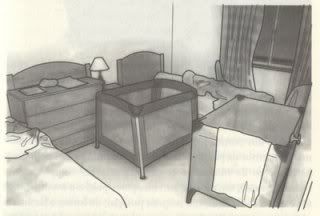
The apartment is made up of two bedrooms, a lounge, a kitchen and a bathroom. What immediately jumps out is the order that prevails in the bedroom where Madeleine and the twins were supposed to have slept. There is nothing to indicate that any abductor had passed through the window.
- How high is the window ledge?
- 91 centimetres. There is a bed against the wall under the window, where it looks like someone had slept. At the foot of the bed, against the same wall, there is a wicker armchair. No shoe prints were found on it.
- What distance between the bed and the window ledge?
- 40 centimetres. But no footprints on the bed either.
- OK, so either or: either that window plays no role, or we have a case of two people, one inside and one outside.
(*These two words, with similar pronunciation, are very often confused by those who do not speak fluent Portuguese, which can give rise to misunderstanding. The first means "press," and the second "business.")
It's 10am. After dealing with everyday matters, I join the team of investigators responsible for the Madeleine case. The Leicestershire police are present at these meetings, as well as José Freitas. The latter, aged 46, is descended from Portuguese people who settled in Madeira and emigrated to the United Kingdom to find work and a better standard of living. Violent crime, abduction and illegal confinement are the speciality of this high-ranking Scotland Yard officer, who joined us eighteen days into the investigation - the English authorities consider that the presence of a man who knows Portugal and its culture could facilitate the investigation. He speaks our language with a British accent: until he left - at the time of the McCanns' return to England -, he never managed to say imprensa, which he always pronounced empresa. *
We take stock of the different operations set up, then we examine the photos taken on the night of May 3rd.
The apartment is made up of two bedrooms, a lounge, a kitchen and a bathroom. What immediately jumps out is the order that prevails in the bedroom where Madeleine and the twins were supposed to have slept. There is nothing to indicate that any abductor had passed through the window.
- How high is the window ledge?
- 91 centimetres. There is a bed against the wall under the window, where it looks like someone had slept. At the foot of the bed, against the same wall, there is a wicker armchair. No shoe prints were found on it.
- What distance between the bed and the window ledge?
- 40 centimetres. But no footprints on the bed either.
- OK, so either or: either that window plays no role, or we have a case of two people, one inside and one outside.
(*These two words, with similar pronunciation, are very often confused by those who do not speak fluent Portuguese, which can give rise to misunderstanding. The first means "press," and the second "business.")

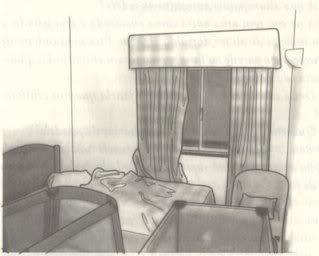
Looking more closely, the room is not as tidy as it first appears to be. The bedroom window is protected by a shutter that only opens from the inside. A black-out curtain, that keeps out the light, comes down to the window ledge. At the sides, just brushing the floor, are two other curtains with tiebacks; they are drawn towards the centre of the window, but not completely closed.

The right-hand tieback has fallen between the foot of the bed and the wicker armchair - the back of which is stuck to the curtain. On the left, the tieback is hanging from its holder, but the curtain isn't straight, as if someone had tried to close it in a hurry. While the tiebacks should have been hooked up, none was in the correct position. Kate insists that the curtains had been completely closed, and that the abductor must have half-opened them to facilitate his escape through the window. But the tiebacks serve to hold the curtains to the sides while they are open; to close them, of course, they must be unhooked. So, it's in pulling the curtains to close them that they would inevitably be in that position. It could reasonably be thought that the abductor had tried to close the curtains after he went through; that would only have slowed him down.
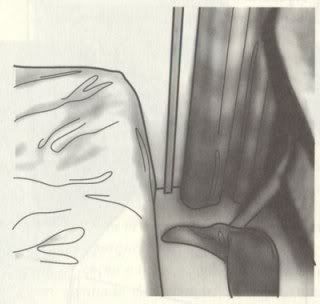
Another hypothesis is to suppose that the curtains had been arranged like that after the disappearance. In that case, we would instead be dealing with an attempt at faking the crime scene.
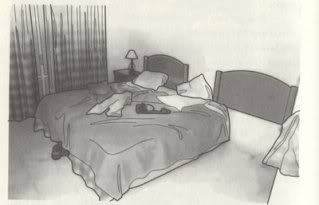
These first observations are not the only ones that lead us to consider a set-up. The way the bed sheets were arranged but also the child's soft toy equally raise doubts.
- Do you see how the sheets are lying? You'd think the child got out by herself....or that she didn't sleep there.
- Someone could have unintentionally touched the curtains while looking for the little girl inside the apartment.
- And the soft toy she slept with? That's not in a natural position either. How would she have found it, along the pillow like that?
- The mother says that the soft toy was beside the pillow when she noticed the disappearance, which, according to her, was its usual place.
- Which means that the little girl slept without holding it? Children normally clutch their security object to fall asleep. But if that's not the case here, the way it's placed doesn't seem natural. She would inevitably have moved it turning over in her sleep.
- The pink blanket is also really tidy, almost folded.
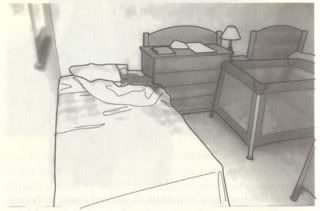

Another hypothesis is to suppose that the curtains had been arranged like that after the disappearance. In that case, we would instead be dealing with an attempt at faking the crime scene.
These first observations are not the only ones that lead us to consider a set-up. The way the bed sheets were arranged but also the child's soft toy equally raise doubts.
- Do you see how the sheets are lying? You'd think the child got out by herself....or that she didn't sleep there.
- Someone could have unintentionally touched the curtains while looking for the little girl inside the apartment.
- And the soft toy she slept with? That's not in a natural position either. How would she have found it, along the pillow like that?
- The mother says that the soft toy was beside the pillow when she noticed the disappearance, which, according to her, was its usual place.
- Which means that the little girl slept without holding it? Children normally clutch their security object to fall asleep. But if that's not the case here, the way it's placed doesn't seem natural. She would inevitably have moved it turning over in her sleep.
- The pink blanket is also really tidy, almost folded.

Where cases of missing children involve the close family, modification of the crime scene is common. But the comings and goings and searches inside the apartment might be the source of these changes. We have to be absolutely sure that it's not a deliberate attempt to put up a smokescreen.
- What does the father say?
- That when he came to see the children, it was all like that, the blanket and the soft toy.
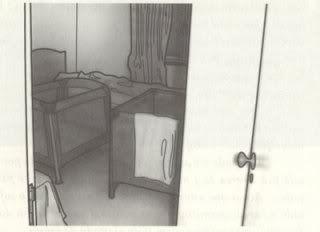
We carry on looking at the photos of the bedroom: the two cots are in the middle of the room and are in the way of an adult moving around.
- Why is there nothing more than mattresses? All the bed linen has been removed. I really wonder why...
- Perhaps a child vomited or soiled the sheets, and they didn't want to leave them in that state...
- The twins only woke up when they were being transferred to the other apartment. They sleep deeply, those English children...
- Yeh! No joking!
- Actually, I'm not joking, I'm thinking aloud...All the same, it's extraordinary. These English little ones are on holiday; in spite of the excitement they must be feeling, they go to sleep every day at the same time. Their sleep is so deep and so calm that they are almost to be envied.
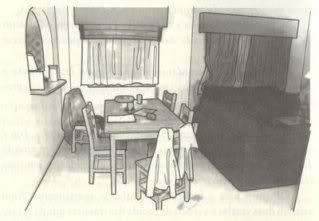
We then examine the photo of the lounge. This room has three openings: two windows and a patio door that opens at the back onto a balcony, from where you can see the area with the swimming pools and restaurants and the road. It is this patio door - and not the front door - that is used when you want to get into the apartment more quickly, coming from the restaurant. We notice that the sofa, situated under one of the windows, has been moved: the back of it is crushing the thick curtains. If these were closed to keep the light out of the room, it's curious that those at the other window were left open.
- That sofa could have been moved when they searched the apartment looking for the little girl.
- It's possible, but consider: the window is 3 metres above the road and directly overlooks the pavement. You can bet your life that the parents were not going to leave the sofa pushed against the wall and risk seeing their children climbing onto it and falling.
- What does the father say?
- That when he came to see the children, it was all like that, the blanket and the soft toy.
We carry on looking at the photos of the bedroom: the two cots are in the middle of the room and are in the way of an adult moving around.
- Why is there nothing more than mattresses? All the bed linen has been removed. I really wonder why...
- Perhaps a child vomited or soiled the sheets, and they didn't want to leave them in that state...

- The twins only woke up when they were being transferred to the other apartment. They sleep deeply, those English children...
- Yeh! No joking!
- Actually, I'm not joking, I'm thinking aloud...All the same, it's extraordinary. These English little ones are on holiday; in spite of the excitement they must be feeling, they go to sleep every day at the same time. Their sleep is so deep and so calm that they are almost to be envied.
We then examine the photo of the lounge. This room has three openings: two windows and a patio door that opens at the back onto a balcony, from where you can see the area with the swimming pools and restaurants and the road. It is this patio door - and not the front door - that is used when you want to get into the apartment more quickly, coming from the restaurant. We notice that the sofa, situated under one of the windows, has been moved: the back of it is crushing the thick curtains. If these were closed to keep the light out of the room, it's curious that those at the other window were left open.
- That sofa could have been moved when they searched the apartment looking for the little girl.
- It's possible, but consider: the window is 3 metres above the road and directly overlooks the pavement. You can bet your life that the parents were not going to leave the sofa pushed against the wall and risk seeing their children climbing onto it and falling.

- Nothing surprises me any more on the part of those parents.
- Yes, but why did they push the sofa back under the window so hastily, judging by the position of the curtains.
- No doubt it was during the searches; that could have been done by a police officer or anyone else who was present in the house.
It's the father who clarifies this point for us. He, himself, pushed the sofa against the wall because the children would not stop playing behind it. He did not consider the possibility of a fall from the window. The role of this sofa is important if you imagine the hypothesis, not of an abduction, but of an accident inside the apartment itself. If it was really away from the wall before the abduction, it may be that Madeleine had climbed onto it and fallen down the other side.
At this stage of the investigation, we have already requested the holiday photos from all of them. On the dining table, we notice a digital camera and we decide that we must acquire its contents.
- We are really going to need the photos. That would allow us to see exactly what took place during dinner, how they were seated round the table, what they drank, what they ate, how they were dressed, everything is important.
- In fact, do you know that the little girl's father got on his knees imploring the GNR police officers to help him when they arrived?
- That man, usually so cold, apparently lost control?
- ???
- Contamination... deliberately make his trousers dirty to hide compromising marks...
- I think you're watching too many thrillers. Don't forget that it's his daughter who has disappeared!
- There are two beds in the parents' bedroom, which have been pushed together; there is a wide space on the right, up to the wardrobe. One of the two beds has visibly not been occupied.
- Yes, but why did they push the sofa back under the window so hastily, judging by the position of the curtains.
- No doubt it was during the searches; that could have been done by a police officer or anyone else who was present in the house.
It's the father who clarifies this point for us. He, himself, pushed the sofa against the wall because the children would not stop playing behind it. He did not consider the possibility of a fall from the window. The role of this sofa is important if you imagine the hypothesis, not of an abduction, but of an accident inside the apartment itself. If it was really away from the wall before the abduction, it may be that Madeleine had climbed onto it and fallen down the other side.
At this stage of the investigation, we have already requested the holiday photos from all of them. On the dining table, we notice a digital camera and we decide that we must acquire its contents.
- We are really going to need the photos. That would allow us to see exactly what took place during dinner, how they were seated round the table, what they drank, what they ate, how they were dressed, everything is important.
- In fact, do you know that the little girl's father got on his knees imploring the GNR police officers to help him when they arrived?
- That man, usually so cold, apparently lost control?
- ???
- Contamination... deliberately make his trousers dirty to hide compromising marks...
- I think you're watching too many thrillers. Don't forget that it's his daughter who has disappeared!
- There are two beds in the parents' bedroom, which have been pushed together; there is a wide space on the right, up to the wardrobe. One of the two beds has visibly not been occupied.

- I don't understand the point of leaving so much space on the right.
- Normally, one of the two cots was there.
- So, the couple slept in that bedroom with the twins, and Madeleine in the other? OK... But why, on that night, are the three children sleeping alone in the other bedroom?
- Not necessarily alone. In the photo, you can clearly see that the second bed, under the window, has been occupied.
- So, only one person slept in the parents' bedroom.
- The mother would have left the father to sleep alone? That could mean there was trouble between them?
- Now, they walk around hand-in-hand. And as if something had changed during the holiday?
- So many issues to be clarified.... Is that a little box of.....pills?
- No, no, it's Band-aids.
- Where is their medication? None has been found, not even a bit of Benuron*. For doctors...
- Perhaps they took it with them when they took the twins from the apartment. Now, it's a bit late to clear up that detail.
- The little ones weren't ill, so why were their parents eager to take the medication along with them?
- Perhaps it was intentional, perhaps not..
- Or it's quite simply at the bottom of a bag, and no one thought to ask them about it.
(* Medication for everyday use - paracetamol - for pain and fever)
- Normally, one of the two cots was there.
- So, the couple slept in that bedroom with the twins, and Madeleine in the other? OK... But why, on that night, are the three children sleeping alone in the other bedroom?
- Not necessarily alone. In the photo, you can clearly see that the second bed, under the window, has been occupied.
- So, only one person slept in the parents' bedroom.
- The mother would have left the father to sleep alone? That could mean there was trouble between them?
- Now, they walk around hand-in-hand. And as if something had changed during the holiday?
- So many issues to be clarified.... Is that a little box of.....pills?
- No, no, it's Band-aids.
- Where is their medication? None has been found, not even a bit of Benuron*. For doctors...
- Perhaps they took it with them when they took the twins from the apartment. Now, it's a bit late to clear up that detail.
- The little ones weren't ill, so why were their parents eager to take the medication along with them?
- Perhaps it was intentional, perhaps not..
- Or it's quite simply at the bottom of a bag, and no one thought to ask them about it.
(* Medication for everyday use - paracetamol - for pain and fever)
Madeleine McCann: L'Enquête Interdite - The Truth Of The Lie - Chapter 12
A RATHER WEAK MONITORING SYSTEM
One of the main difficulties in this investigation was to reconstruct the chronology of events. To determine the exact time of Madeleine's disappearance, we were dependent on the witness statements of the parents and friends. There is no doubt that the adults (apart from the Paynes, who were using a baby monitor) were taking regular turns during dinner to check that the children were asleep - the restaurant's register confirms it. Nevertheless, after the meal, the children could sometimes be left for more than an hour without supervision. Until May 3rd, the adults made the trip every 30 minutes; on that night, according to what the group said, the intervals between visits did not exceed 15 minutes.
TWO CONTRADICTORY LISTS AND A TORN UP CHILDREN'S BOOK
It is Russell O'Brien, who hands over to the first police officer to arrive on the scene, two lists written on the cover of a children's sticker album, that probably belonged to Madeleine. How come it had been torn up? A child has just disappeared and one of her books is used to write on? That pays very little consideration to...Didn't they have anything else to hand, a slip of paper or a paper napkin? Another unanswered question.
These two lists describe, hour by hour, how the evening progressed.
On the first, we read:
8.45pm - All assembled at poolside for food.
9.00pm - Matt Oldfield listens at all three windows 5A,B,D
ALL shutters down.
9.15pm - Gerry McCann looks at room A ? Door open to bedroom.
9.20pm - Jane Tanner checkS 5D - Sees stranger walking, carrying a child.
9.30pm - Russell O'Brien in 5D - poorly daughter.
9.55pm
10pm - Alarm raised after Kate
(At the bottom of this list is the name GERALD in block capitals.)
On the second list differences are noted that are not trivial.
8.45 - pool
Matt returns 9.00 - 9.05 - listened at all three.
- all shutters down.
Jerry - 9 10 - 9.15 in to room - all well
? did he check?
9.20/5 - (??) Jane checked 5D Sees stranger I child.
9.30 - Russ + ( word scored through) Matt check all three
9.35 - Matt checks door Sees twins
9.50 Russ returns
9.55 - Kate (word indecipherable) Madeleine
10.pm - Alarm raised.
(Translator's note: I have tried to copy the above from the originals.)
The writing is irregular, the syntax unconventional and the description of comings and goings confused. Why two lists? And why, in the first, is apartment 5A left for 45 minutes without checking?
If the witness statements from employees and tourists are to be believed, once the alert was raised - the time is also vague, between 10pm and 10.30pm according to the investigators -, all the dinner guests rushed to the apartment, as if there was a medical emergency. Only the grandmother, Diane Webster, stayed at the table for a few more minutes. It is highly likely that inside the apartment, they went through the consequences of their actions and the failure of their monitoring system. To minimise their responsibility and not be accused of negligence, it was necessary for them to augment the frequency of their visits. With the checks so close together, who could imagine that someone would get into the apartment? It was quite simply impossible.
The existence of two lists proves that there was a debate; the differences between them probably mean that there was no interest in being accurate.
For a reason of which we are unaware, the friends have to state that Jane saw a man carrying a child at around 9.20 - 9.25pm, and between that time and the alert (towards 10pm), someone from the group went to the apartment, saw the twins in the bedroom, but cannot guarantee that Madeleine was still there. According to the second list, it is Matthew Oldfield, whom the first list says only listened at the windows of apartments 5A, 5B. and 5D; still according to that same list, he was allegedly accompanied by Russell O'Brien at around 9.30pm and saw the twins at around 9.35pm.
Matthew Oldfield's behaviour is perplexing. According to the two time-lines, Gerald's statements and his own affirmations, he and Russell left the restaurant at around 9.30pm to go their respective apartments. Matthew entered his accommodation by the front door, left again that way after glancing at his children, crossed the car park and walked round the building to go into the McCanns' apartment by the rear patio door - the only one not to have been locked. He then went to the children's bedroom. In the first list, there is no mention of this visit: Matthew contented himself with listening at the windows; in the second, Russell notes that his friend saw the twins at 9.35pm.
In the course of the statement which he made to the PJ, Matthew certifies having gone to the McCann's apartment at 9.25pm, having definitely seen the twins and noticing a definite light. What he doesn't explain, is how he could pass the bedroom window twice without noticing that it was open. On the other hand, once inside, he noticed that it was. That happens to conveniently reinforce the hypothesis of an abduction and gives weight to Jane Tanner's witness statement.
- Interesting! From 9.10pm, the intervals between visits go down to 5 minutes and not more than 15.
- Why did they need to tighten up the monitoring?
- Perhaps simply because it was at that time that it all happened.
We deduce from this that the alert was bound to have been raised before 10pm. Matthew Oldfield's and Jane Tanner's witness statements contradict each other. Those of Matthew and Kate too: the latter insists that when she went into the apartment, the bedroom door banged shut, the window was wide open and the curtains were raised by the wind. However, Matthew said nothing about all of that, only "a definite light," in the bedroom. This is rather implausible: from his vantage point - the bedroom doorway -, the line of sight between the door and the window is limited to a straight line of close to 4 metres. Which means that if the window had been open, he would inevitably have noticed it. Why such vagueness? Another obvious mistake concerns the number of windows: he mentioned two, while in reality, there was only one. His wife repeated the same mistake when she stated that her husband had listened at two bedroom windows during his second round.
Another question concerns Jane Tanner's second visit to apartment 5D. According to what the group says, at 9.30pm, Matt Oldfield accompanied Russell O'Brien as far as his accommodation, 5D, and both heard a child crying. Russell then stayed there. When Matt returned to the Tapas to let Jane know that their daughter was ill, the latter went to the child's bedside, in 5D, and did not come back.
These contradictions cannot hide the reality: the safety of the children left a lot to be desired.
One of the main difficulties in this investigation was to reconstruct the chronology of events. To determine the exact time of Madeleine's disappearance, we were dependent on the witness statements of the parents and friends. There is no doubt that the adults (apart from the Paynes, who were using a baby monitor) were taking regular turns during dinner to check that the children were asleep - the restaurant's register confirms it. Nevertheless, after the meal, the children could sometimes be left for more than an hour without supervision. Until May 3rd, the adults made the trip every 30 minutes; on that night, according to what the group said, the intervals between visits did not exceed 15 minutes.
TWO CONTRADICTORY LISTS AND A TORN UP CHILDREN'S BOOK
It is Russell O'Brien, who hands over to the first police officer to arrive on the scene, two lists written on the cover of a children's sticker album, that probably belonged to Madeleine. How come it had been torn up? A child has just disappeared and one of her books is used to write on? That pays very little consideration to...Didn't they have anything else to hand, a slip of paper or a paper napkin? Another unanswered question.
These two lists describe, hour by hour, how the evening progressed.
On the first, we read:
8.45pm - All assembled at poolside for food.
9.00pm - Matt Oldfield listens at all three windows 5A,B,D
ALL shutters down.
9.15pm - Gerry McCann looks at room A ? Door open to bedroom.
9.20pm - Jane Tanner checkS 5D - Sees stranger walking, carrying a child.
9.30pm - Russell O'Brien in 5D - poorly daughter.
9.55pm
10pm - Alarm raised after Kate
(At the bottom of this list is the name GERALD in block capitals.)
On the second list differences are noted that are not trivial.
8.45 - pool
Matt returns 9.00 - 9.05 - listened at all three.
- all shutters down.
Jerry - 9 10 - 9.15 in to room - all well
? did he check?
9.20/5 - (??) Jane checked 5D Sees stranger I child.
9.30 - Russ + ( word scored through) Matt check all three
9.35 - Matt checks door Sees twins
9.50 Russ returns
9.55 - Kate (word indecipherable) Madeleine
10.pm - Alarm raised.
(Translator's note: I have tried to copy the above from the originals.)
The writing is irregular, the syntax unconventional and the description of comings and goings confused. Why two lists? And why, in the first, is apartment 5A left for 45 minutes without checking?
If the witness statements from employees and tourists are to be believed, once the alert was raised - the time is also vague, between 10pm and 10.30pm according to the investigators -, all the dinner guests rushed to the apartment, as if there was a medical emergency. Only the grandmother, Diane Webster, stayed at the table for a few more minutes. It is highly likely that inside the apartment, they went through the consequences of their actions and the failure of their monitoring system. To minimise their responsibility and not be accused of negligence, it was necessary for them to augment the frequency of their visits. With the checks so close together, who could imagine that someone would get into the apartment? It was quite simply impossible.
The existence of two lists proves that there was a debate; the differences between them probably mean that there was no interest in being accurate.
For a reason of which we are unaware, the friends have to state that Jane saw a man carrying a child at around 9.20 - 9.25pm, and between that time and the alert (towards 10pm), someone from the group went to the apartment, saw the twins in the bedroom, but cannot guarantee that Madeleine was still there. According to the second list, it is Matthew Oldfield, whom the first list says only listened at the windows of apartments 5A, 5B. and 5D; still according to that same list, he was allegedly accompanied by Russell O'Brien at around 9.30pm and saw the twins at around 9.35pm.
Matthew Oldfield's behaviour is perplexing. According to the two time-lines, Gerald's statements and his own affirmations, he and Russell left the restaurant at around 9.30pm to go their respective apartments. Matthew entered his accommodation by the front door, left again that way after glancing at his children, crossed the car park and walked round the building to go into the McCanns' apartment by the rear patio door - the only one not to have been locked. He then went to the children's bedroom. In the first list, there is no mention of this visit: Matthew contented himself with listening at the windows; in the second, Russell notes that his friend saw the twins at 9.35pm.
In the course of the statement which he made to the PJ, Matthew certifies having gone to the McCann's apartment at 9.25pm, having definitely seen the twins and noticing a definite light. What he doesn't explain, is how he could pass the bedroom window twice without noticing that it was open. On the other hand, once inside, he noticed that it was. That happens to conveniently reinforce the hypothesis of an abduction and gives weight to Jane Tanner's witness statement.
- Interesting! From 9.10pm, the intervals between visits go down to 5 minutes and not more than 15.
- Why did they need to tighten up the monitoring?
- Perhaps simply because it was at that time that it all happened.
We deduce from this that the alert was bound to have been raised before 10pm. Matthew Oldfield's and Jane Tanner's witness statements contradict each other. Those of Matthew and Kate too: the latter insists that when she went into the apartment, the bedroom door banged shut, the window was wide open and the curtains were raised by the wind. However, Matthew said nothing about all of that, only "a definite light," in the bedroom. This is rather implausible: from his vantage point - the bedroom doorway -, the line of sight between the door and the window is limited to a straight line of close to 4 metres. Which means that if the window had been open, he would inevitably have noticed it. Why such vagueness? Another obvious mistake concerns the number of windows: he mentioned two, while in reality, there was only one. His wife repeated the same mistake when she stated that her husband had listened at two bedroom windows during his second round.
Another question concerns Jane Tanner's second visit to apartment 5D. According to what the group says, at 9.30pm, Matt Oldfield accompanied Russell O'Brien as far as his accommodation, 5D, and both heard a child crying. Russell then stayed there. When Matt returned to the Tapas to let Jane know that their daughter was ill, the latter went to the child's bedside, in 5D, and did not come back.
These contradictions cannot hide the reality: the safety of the children left a lot to be desired.
Madeleine McCann: L'Enquête Interdite - The Truth Of The Lie - Chapter 13

CONTRADICTIONS OR CLUES
How do you explain the differences, from one to another, between the witness statements? What comes immediately to mind is that the parents did not want to be thought of as irresponsible adults. What would people think of these tourists - doctors moreover - who leave their very small children alone in their bedroom, while they dine amongst friends - a well-watered meal, since they usually consume eight bottles of wine, according to witness statements. They were bound to be all the more panic-stricken, given that they were abroad and going to have to deal with a police force and a law which they knew nothing about. So, it was important for them to maintain that the children were safe.
However, none of the buildings was equipped with a security door: on the contrary, it was simple wood-paneled doors equipped with ordinary locks. The Oldfield and O'Brien families, who also occupied ground floor accommodation, considered their children to be in a safe place since all the doors were locked. They forgot about the patio doors opening onto a little balcony at the rear of the building, which they could not watch from their table. The McCanns did not think any differently, even though the patio door wasn't locked and that, from the restaurant, as we have already mentioned, the building could barely be made out...That means that anyone could have got into their apartment without being seen. Kate Healy has always insisted that she went into her apartment the back way while Gerry says he went through the main door, the one at the front, which he opened with his key. Jeremy W., a tourist, who was returning from a walk with his baby, confirms having spoken to him for a few minutes while he was coming out of his apartment by the garden gate, at the rear. Not only is this detail important, but it becomes crucial in understanding what happened during the night of May 3rd.
- Why does Gerald insist that he went in the front way when it's quicker to go the back way?
- To show that his children were safe.
- Matt Oldfield assures us that the first time he went to check on the children, he contented himself with listening at the windows. He didn't hear anyone crying.
- His meal is going cold and, instead of using the back way for speed, he makes this long detour to listen at the windows at the front...?
- Yes, but don't forget that, apart from the McCanns, the others had locked their patio doors, so he would inevitably have had to go round.
- But when Matt goes with Russell, he enters his apartment round the front, comes out, walks round the building and goes into the McCanns' the back way.
- Gerald should have given him his key. He would have gone in the front way and left by the back way, thus saving a good hundred metres.
Besides these inconsistencies, several facts place in doubt the veracity of the witness statements - and the very existence of an abductor.
Anybody accessing the block from the front sees the windows of 5A, 5B and 5D very clearly: they're all on the same level, and are relatively close together. If Jane came across the abductor in the street, as she claims, that means that he was no longer in apartment 5A. As a consequence, the window which Kate says she found wide open, would have been open at that time. But Jane was not aware of this detail and she never spoke of it. When she went back to her apartment to replace her partner Russell sitting with their daughter, she had another opportunity to notice it. But, once again, she noticed nothing.
Jane is certainly not very observant. This remark goes equally for her friends Matt and Russell: both take the same route, alongside all those windows without noticing that one of them is wide open.
Someone has to have lied. Kate Healy's statements leave a lot to be desired. This is the gist of it: she goes in, notices Madeleine's absence, the open window, the shutter raised and the curtains moving in the breeze. OK. The classic scenario of an abduction by an individual having gone in through the window, which is to some extent corroborated by Jane Tanner, since the man she saw was coming from the car park, just in front of the window in question.
Looking at what follows: Kate looks for Madeleine all over the apartment and, not finding her, goes running towards the Tapas, shouting, "We let her down!" Looking a little more closely at the facts.
The mother has just discovered:
- that there are only two children in the bedroom;
- that the window is wide open.
And she goes back to the Tapas leaving the twins alone again? In a bedroom with windows wide open, at night, when it's cold and an abductor is hanging about?
Such behaviour is hardly credible and difficult to justify, even in the grip of panic. A mother would not react like that, she would protect her two other children and not abandon them in their turn. She could have shouted help from the veranda to alert her husband and her friends. She could also have called him on his mobile phone...We find no plausible explanation for her conduct.
Going back to the window, there is no doubt that it was opened at some point. When Amy T., one of the workers from the nursery, heard the alarm drawing attention to the disappearance shortly after 10pm, she went to apartment 5A. She noted that the window was just half-open and the shutter was raised. The twins were still asleep.
Madeleine McCann: L'Enquête Interdite - The Truth of The Lie - Chapter 14

MADELEINE'S PARENTS CALL ATTENTION TO HER DEATH
(Pictured right: Daniel Krugel.)
At the end of May, my wife Sofia visits me at the offices of the Department of Criminal Investigation in Portimão. She brings a flower basket filled with orchids, roses, lilies, and gerberas, decorated with butterflies and birds in shades of green and yellow, the two colours symbolising the mobilisation of effort around Madeleine. A little note from my daughters accompanies it: "Papa, we love you, don't forget about us, but find Madeleine. Rita and Inès." That bouquet stayed in my office, withering as the days went by and the hope of finding Madeleine alive dwindled.
It is at this time that, suddenly, the parents seem to admit the possibility of their daughter's death. Afterwards - and to this day, if I am not mistaken -, they take exception to this hypothesis. Perhaps we were being naive, but it had seemed to us that Kate was going to provide us, indirectly, with indications about where her daughter's body was to be found. For example, at the beginning of June, she informed us that the body could have been hidden in the outlet of a sewer pipe at Praia da Luz, or on the cliffs to the west of the beach, where she happened to run. She will say later that this information had been given to her by mediums possessing psychic power.
IN SEARCH OF A BODY, WITH KRUGEL'S MACHINE
Kate had heard of a man called Krugel, a former South African army colonel, who had allegedly perfected a machine enabling him to detect the presence of a body. A decomposing body emits particles: if hair from the deceased person is placed in the machine, it detects identical particles. On June 9th, Kate asks friends to go to her home in England to collect some of her daughter's hair and send it to Krugel.
On June 28th, the McCanns request Krugel's presence in the Algarve. They want to make his intervention official and seek the agreement of the PJ. Thanks to Madeleine's hair, the South African allegedly determined a sort of imaginary line that allowed him to state that the body was in the Vila da Luz area. The Portuguese and English police learn, with amazement, about these supposed cutting-edge technologies dedicated to locating bodies. Of course, we knew that such apparatus existed, especially in the United States, but Krugel's mysterious, "machine," leaves us all speechless. Kate and Gerry, they stick to their guns. They saw a television programme in which the effectiveness of Krugel's method was demonstrated, and so are persuaded that the man will be able to move the investigation forward. Without being convinced as to the validity of the method, the police end up acceding to their request.
The show is about to begin.
At customs - in South Africa as well as in Portugal -, Krugal refuses to allow his machine to be submitted to security control: it must be neither x-rayed nor opened. He claims that this would damage it and that his production secret risked being unveiled. Finally, after long hours of negotiation, the man, his apparatus and the journalist accompanying them take off for the Algarve. It's now the middle of July. In late afternoon, they are driven to the Department of Criminal Investigation in Portimão, where a PJ team of investigators is waiting for them. They suggest that we watch a video about this famous invention - produced by the woman accompanying him - so that we can judge for ourselves. We are still not convinced. The following day, a few inspectors accompany Krugel to Praia da Luz for him to officiate.
Operations progress in the following manner.
1) Krugel climbs to the highest point west of Praia da Luz, places a hair into the machine and traces an imaginary line in an easterly direction.
2) He repeats the operation to the north of Praia da Luz and traces another line towards the south.
3) He then determines the point of intersection of these two lines.
4) From this point, he defines a corridor about 300 metres wide, bound by the cliffs on the right and the Roman Baths on the left.
The inventor then states: "Madeleine's body is in this area." The National Guard - who had already combed this area after the disappearance - conduct more searches. Once again, to no avail. As harassed when he left as when he arrived, Krugel goes back to South Africa, taking machine and journalist with him.
Madeleine McCann: L'Enquête Interdite - The Truth of The Lie - Chapter 15
MEMORY OF A CRIME
The presence or otherwise of a body considerably changes the way investigations are led. In the first instance - at least where the legal definition of a crime is concerned -, the investigation is facilitated. The body is identified, autopsied and then, with the help of any clues picked up, the cause of death is determined. If the conclusion is violent death, caused by a third party, research can get underway from a reliable point of departure.
Faced with a person's disappearance, the situation is more difficult. It's impossible to say that it's a criminal matter, and police officers have to start their investigation not knowing if the individual they are looking for is alive or dead.
If he is alive, he may have disappeared of his won free will - it is then necessary to understand the reasons in order to direct the searches - or been the victim of an abduction - the reasons for such an act are complex: ransom demand, vengeance, paedophilia, etc.
If the missing person is thought to be dead, the death is not necessarily murder: it could have resulted from an accident or third-party negligence. But without a body, we can be sure of nothing.
A BODY TELLS THE STORY OF A CRIME
I remember the Mariana case, about a little three-year-old girl kicked to death by her own father in 1999 - I was working in Açores then, at the PJ's Ponta Delgada Department of Criminal Investigation.
At 8 o'clock one Monday morning, a woman doctor, required to issue the death certificate for a child, notices that her body is covered in suspicious injuries. She alerts us immediately. We arrive at the family home. The mother is sitting on a blood-soaked towel which she is trying, unsuccessfully, to hide. The parents relate that little Mariana died in her sleep, that she allegedly choked on her feeding bottle. A pitiful lie, that does not stand up to even superficial examination of the body. Signs of violent blows are visible on her back and on her buttocks: these are imprints from the soles of the father's boots. Mariana is showing serious injuries to her skull. After having pummeled her with kicks, the father hurled her, with all his strength, against the wall. Then, grabbing her by the hair, he violently hit her head several times against the bedroom wall, under the passive gaze of the mother. Animal violence that killed Mariana. The parents then decided to get rid of the body legally, by requesting a death certificate. Tragic mistake. They faked the crime scene, washed the blood off the walls and places where the father had hit the little girl. To get rid of all trace of the crime, they threw into the bin the denim skirt that the little girl wore for the first time that Sunday. The garment covered in dust and the torn out shoulder straps attest to the violence suffered.
Mariana had simply asked to visit her godmother who lived opposite; the father, jealous, mad with rage, lashed out at her, to the point of killing her.
After the examination of the body, the medical examiner and the investigator were in no doubt: Mariana had been savagely killed by her father with the passive consent of the mother, and in front of her 5 year-old brother. In the present case, the perpetrators of the crime did not seek to hide a body but to cover up the truth.
At the time of the confessions, the man described the scene for us in a very cold way, factually, showing not the slightest regret. I had to leave my colleague to continue the interrogation alone. I was so upset. How could a father come to kill his own child? I had to get a grip on myself, I had experienced such things before.....I needed all my composure if I wanted to continue the investigation with the required objectivity. Truth and justice, that's all that remains for these children.
I have often related this case to colleagues to show them to what extent a body can, "talk," to investigators, help them to discover what really happened. Unlike other individuals, these two had neither the imagination nor the intelligence to hide the remains. In order to conceal his crime, the murderer can hide the body, or alter the crime scene in such a way as to divert suspicion. But this is not always the case. Someone may also get rid of a body without having committed a criminal act. For what reasons? Fear, for example, of being judged by his peers.
Imagine a couple of doctors going on holiday abroad, to a country they hardly know. They leave their three children to sleep alone in their apartment to go to a restaurant, a hundred metres away. When they come back, one of the children is dead. It could be an accident or murder. What do they do? They call the police and, in a way, admit that they were more than negligent. And what will happen when they go back home? What will the consequences be? Will their professional future be compromised? Will they be charged? Will they retain custody of the younger ones?
As I said at the start of the book, no lead must be abandoned while it has not technically been ruled out. In the course of the investigation, with the discovery of more details, some prove to be more encouraging than others and, for that reason, must be gone into more thoroughly. The overall scope changes. At a certain stage in the investigation, to explain Madeleine's disappearance, we had considered the scenario of the concealment of a body. But before coming to that conclusion, we had to exhaust all leads that favoured the theory of abduction.
THE CRIME SCENE IS NOT MEANINGLESS
The place the person disappeared from is the true point of departure for the investigation. It's the spot where clues are concentrated that will direct the research: finger prints, biological samples, blood and other traces. The apartment where Madeleine slept, similar to so many others, differs however on two fundamental points, which add to the difficulties of our work. It's a holiday apartment that acquires new guests every week: moreover, it is situated in a hotel complex in which hundreds of employees are moving around.
The situation is not the same when a child disappears from her usual place of residence. There, she is known, has routines, people encounter her every day with her family. It's not difficult to find out what she was doing in the hours preceding her disappearance.
In a holiday village, there is very little time available to gather the maximum number of witness statements, since some tourists are already on the point of departure. Those not achieved have to be left to the goodwill of the police authorities of the country of origin. Because of the great number of people to interview, a few days are needed to obtain an overall view of the situation. One thing is sure: only the accumulation of many witness statements enables the piecing back together of the puzzle of the events.
The presence or otherwise of a body considerably changes the way investigations are led. In the first instance - at least where the legal definition of a crime is concerned -, the investigation is facilitated. The body is identified, autopsied and then, with the help of any clues picked up, the cause of death is determined. If the conclusion is violent death, caused by a third party, research can get underway from a reliable point of departure.
Faced with a person's disappearance, the situation is more difficult. It's impossible to say that it's a criminal matter, and police officers have to start their investigation not knowing if the individual they are looking for is alive or dead.
If he is alive, he may have disappeared of his won free will - it is then necessary to understand the reasons in order to direct the searches - or been the victim of an abduction - the reasons for such an act are complex: ransom demand, vengeance, paedophilia, etc.
If the missing person is thought to be dead, the death is not necessarily murder: it could have resulted from an accident or third-party negligence. But without a body, we can be sure of nothing.
A BODY TELLS THE STORY OF A CRIME
I remember the Mariana case, about a little three-year-old girl kicked to death by her own father in 1999 - I was working in Açores then, at the PJ's Ponta Delgada Department of Criminal Investigation.
At 8 o'clock one Monday morning, a woman doctor, required to issue the death certificate for a child, notices that her body is covered in suspicious injuries. She alerts us immediately. We arrive at the family home. The mother is sitting on a blood-soaked towel which she is trying, unsuccessfully, to hide. The parents relate that little Mariana died in her sleep, that she allegedly choked on her feeding bottle. A pitiful lie, that does not stand up to even superficial examination of the body. Signs of violent blows are visible on her back and on her buttocks: these are imprints from the soles of the father's boots. Mariana is showing serious injuries to her skull. After having pummeled her with kicks, the father hurled her, with all his strength, against the wall. Then, grabbing her by the hair, he violently hit her head several times against the bedroom wall, under the passive gaze of the mother. Animal violence that killed Mariana. The parents then decided to get rid of the body legally, by requesting a death certificate. Tragic mistake. They faked the crime scene, washed the blood off the walls and places where the father had hit the little girl. To get rid of all trace of the crime, they threw into the bin the denim skirt that the little girl wore for the first time that Sunday. The garment covered in dust and the torn out shoulder straps attest to the violence suffered.
Mariana had simply asked to visit her godmother who lived opposite; the father, jealous, mad with rage, lashed out at her, to the point of killing her.
After the examination of the body, the medical examiner and the investigator were in no doubt: Mariana had been savagely killed by her father with the passive consent of the mother, and in front of her 5 year-old brother. In the present case, the perpetrators of the crime did not seek to hide a body but to cover up the truth.
At the time of the confessions, the man described the scene for us in a very cold way, factually, showing not the slightest regret. I had to leave my colleague to continue the interrogation alone. I was so upset. How could a father come to kill his own child? I had to get a grip on myself, I had experienced such things before.....I needed all my composure if I wanted to continue the investigation with the required objectivity. Truth and justice, that's all that remains for these children.
I have often related this case to colleagues to show them to what extent a body can, "talk," to investigators, help them to discover what really happened. Unlike other individuals, these two had neither the imagination nor the intelligence to hide the remains. In order to conceal his crime, the murderer can hide the body, or alter the crime scene in such a way as to divert suspicion. But this is not always the case. Someone may also get rid of a body without having committed a criminal act. For what reasons? Fear, for example, of being judged by his peers.
Imagine a couple of doctors going on holiday abroad, to a country they hardly know. They leave their three children to sleep alone in their apartment to go to a restaurant, a hundred metres away. When they come back, one of the children is dead. It could be an accident or murder. What do they do? They call the police and, in a way, admit that they were more than negligent. And what will happen when they go back home? What will the consequences be? Will their professional future be compromised? Will they be charged? Will they retain custody of the younger ones?
As I said at the start of the book, no lead must be abandoned while it has not technically been ruled out. In the course of the investigation, with the discovery of more details, some prove to be more encouraging than others and, for that reason, must be gone into more thoroughly. The overall scope changes. At a certain stage in the investigation, to explain Madeleine's disappearance, we had considered the scenario of the concealment of a body. But before coming to that conclusion, we had to exhaust all leads that favoured the theory of abduction.
THE CRIME SCENE IS NOT MEANINGLESS
The place the person disappeared from is the true point of departure for the investigation. It's the spot where clues are concentrated that will direct the research: finger prints, biological samples, blood and other traces. The apartment where Madeleine slept, similar to so many others, differs however on two fundamental points, which add to the difficulties of our work. It's a holiday apartment that acquires new guests every week: moreover, it is situated in a hotel complex in which hundreds of employees are moving around.
The situation is not the same when a child disappears from her usual place of residence. There, she is known, has routines, people encounter her every day with her family. It's not difficult to find out what she was doing in the hours preceding her disappearance.
In a holiday village, there is very little time available to gather the maximum number of witness statements, since some tourists are already on the point of departure. Those not achieved have to be left to the goodwill of the police authorities of the country of origin. Because of the great number of people to interview, a few days are needed to obtain an overall view of the situation. One thing is sure: only the accumulation of many witness statements enables the piecing back together of the puzzle of the events.
Madeleine McCann: L'Enquête Interdite - The Forbidden Investigation - Chapter 16

THE HYPOTHESIS OF DEATH IS CONSIDERED.
THE ARRIVAL OF THE SPECIALISTS
After Krugel's unsuccessful visit, our English colleagues vaunt the work of their specialist dog team from the South Yorkshire Police Department of Criminal Investigation. Their dogs are specially trained to locate the most minute traces of blood and are capable of outstanding performance in the search for human remains and bodily fluids.
THE FORENSIC SPECIALISTS
It's July. The hypothesis of death, including by the parents, is being seriously considered. However, no lead has yet come to anything, and we find ourselves in a cul-de-sac. We have to re-centre the investigation around its point of departure, apartment 5A at the Ocean Club, in Vila da Luz. We officially request the help of the best experts in criminology and forensics but also the specialist dog team from the English police. A few days later, we welcome Mark Harrison, a specialist in murder, and the search for missing persons and victims of natural disasters. National advisor to the British police, he is well known for his exceptional professional experience. He has already participated in dozens of international criminal investigations.
His work consists of defining new strategies for research. He gets to work immediately, supported by the Portuguese PJ and the investigators from Leicester and Scotland Yard. On his arrival, we place at his disposal details of the case, as well as all our material and human resources. Harrison reads up on the statements and interviews from the principal witnesses - including, of course, those of the parents and friends -, all the analyses, simulations, hypotheses and cross-checking already carried out. He carries out a reconnaissance on the ground, by helicopter and then on foot. He paces the streets and the access roads to Vila da Luz and compares them to the diagrams created in the course of the investigation. Nothing is left to chance: measurement and timing of possible routes between buildings, apartments and restaurants; analyses, with the help of the best specialists, of weather, geological and maritime factors in relation to the investigation; consultation with the best forensic anthropologist in the country, who indicates for us what would be the actual state of the body in the hypothesis of death occurring on May 3rd; study of the region's natural carrion predators. All the research already conducted by hundreds of people - GNR, civil defence, firemen and other volunteers - is re-examined in detail and re-analysed.
After a week of intense work, Harrison presents the results of his study to my coordinating group. Even if we were expecting it, his conclusions confirm our worst fears. The most plausible scenario is the following: there is no doubt that Madeleine is dead, and her body is hidden somewhere in the area around Praia da Luz. He praises the quality of the work carried out by the Portuguese authorities in trying to find the little girl alive. According to him, the time has come to redirect the searches in order to find, this time, a body hidden in the surrounding area.
AMAZING STATISTICS
Great Britain has at its disposal the world's biggest data bank on homicide of children under five years old. Since 1960, the count is 1528. Harrison is well acquainted with its contents. He often draws information from there which helps him to resolve similar cases. Valuable information can be found there on on various criminal modus operandi, places where bodies are hidden, techniques used to get rid of a body. He relates that on one occasion, thanks to the data, he was able to deduce the maximum distance a body might be found in relation to where the crime had been committed.
The figures quoted in the report he hands over give us the shivers. The crimes, including those of a sexual nature, are committed by the parents in 84% of cases; 96% are perpetrated by friends and relatives. In only 4% of them is the murderer or abductor a total stranger to the victim. In this roundabout way, Mark Harrison points out that the guilty party may be a person close to Madeleine, and even her own parents. From now on, we have to explore this track, especially as the others have proved fruitless.
Harrison also suggests that we use the skills of two totally remarkable dogs: the first an EVRD (Enhanced Victim Recovery Dog), achieves outstanding performance in the detection of human cadaver odour; the second, a CSI dog (Crime Scene Investigation) is capable of smelling the tiniest trace of blood, knowing how to recognise its human origin. To convince us of their capability and the extraordinary work carried out by these very special detectives in the course of over 200 investigations, he screens a video for us, showing their training and their intervention on the ground.
He suggests that we start the operations with the inspection of apartment 5A, then those occupied by the McCanns' friends. Robert Murat's house will also be subjected to thorough examination. In addition, all the vehicles used by all of them will be sniffed by the dogs.
Meanwhile, we were supposed to receive American electronic equipment that detects human bodies thanks to the odour that emanates from them (Scent Transfer Unit 100). But the equipment, blocked by customs, arrived late. We didn't need to use it, having obtained very concrete results, thanks to the dogs.
THE ENGLISH SPECIALIST DOG TEAM
The heat is scorching on this thirtieth day of July 2007 when two Springer Spaniels, Eddie and Keela, get off the British Airways plane, accompanied by their trainer, Martin Grime. An air-conditioned vehicle is waiting to take them to their accommodation. A vet, who will be on hand during their stay, has been brought in to intervene in case of illness or if the dogs get bitten by a snake. Their mission: to find Madeleine's body and expose those responsible.
Eddie has been involved in a great number of cases, helping the police to resolve a good many riddles, thanks to his sense of smell. Even if the body has been moved, objects the body has touched have been contaminated by its odour, especially porous materials, fabrics, the upholstery in cars, etc. And that odour, Eddie knows how to recognise out of a thousand.
Keela, a scenes of crime specialist, is capable of locating particles of blood even after a place has been cleaned with chemical products or bleach. Sometimes, the residues are so microscopic they are missed by the instruments of the forensic police, as sophicticated as they are, and it's impossible to harvest them without taking all of what they are on.
Eddie is always the first to be brought onto a site. Once he has discerned the odour that he knows so well, it's Keela's turn to go into action, on the lookout for the slightest whiff of blood. The simultaneous presence of the two elements in a given place - blood and cavaver odours - is taken to indicate that a body has been there and that it's probably there that the death occurred.
The dogs' CV is impressive. Besides collaborating in hundreds of investigations, they passed the practical tests brilliantly at the FBI's "Body Farm," the only place in the world where human cadavers are used to simulate homicide scenarios and concealment of bodies.
Amongst the most media-covered cases, which they contributed to resolving, is that of the disappearance in Northern Ireland of Attracta Harron, who was last seen when she was returning home on foot, after having been to church. All searches carried out by the police were unsuccessful. The main suspect's car having been totally burnt out in a mysterious fire, couldn't be examined. They called in Eddie, who examined the charred remains of the vehicle and immediately picked out the characteristic odour. Human tissue was found amongst the debris, the DNA of which corresponded to the missing woman. Later, the dog indicated the place - close to a river - where the victim's body had been abandoned. At the home of the suspect, where the police were searching for incriminating evidence, Eddie identified cadaver odour in one of the bedrooms. The man confessed to having killed the woman then moving her body to the banks of the river.
The case of Amanda Edwards, reported missing, is also very impressive. The police, who conducted a search of her ex-partner's home, found small bloodstains there, but no trace of a body. The dog, who was brought in for the examination of the man''s vehicle, alerted to cadaver odour on the tools stored in the boot (a shovel, a level and a compactor). The police went to the building site where the suspect had worked a few days before and discovered the body, buried in a garage. The murderer had made efficient use of his tools to carry out his task.
It's also thanks to the help of the dogs that the case of Charlotte Pinkley, a missing British woman, who had been imprisoned by her ex-partner, was resolved. The police requested the help of the specialist dog team to try to find the young woman's body. Eddie picked out a place where the abductor had provisionally left his victim. In the surrounding area, the investigators found the button from a dress that had belonged to Charlotte. That clue exposed the murderer, who ended up showing the police the place where he had hidden the body.
More recently, it's Eddie who helps to find a body buried under a flagstone at the former orphanage, Haut-de-la-Garenne, in Jersey, setting for a terrible case of paedophilia and child murder.
The achievements of the dog detectives are the result of a very long apprenticeship. It all starts with the selection of the best puppies when they are only a few months old. The most talented breed for this unusual "profession," is the Springer Spaniel. The trainer, Martin Grime, and his pupils undergo aptitude tests every year in order to obtain certificates proving their capability. In Great Britain, the police have no hesitation in calling in the specialist dog teams to assist in certain criminal investigations. Their skills are nowadays recognised by journalists, police and courts all over the world.
EXAMINATION OF THE OCEAN CLUB APARTMENTS BY THE SPECIALIST DOGS
On August 3rd 2007, I am having dinner in Praia da rocha, near Portimão, with my friend Gaivota. Unable to hide my anxiety, I keep looking at my watch and my telephone. Gaivota asks me if everything is OK: I respond with an absent-minded "Yes." A few kilometres away one of the most important search operations ever carried out in Portugal has begun. Perhaps we will finally manage to clear up the mystery of Madeleine's disappearance.
The investigation starts in apartment 5A. The grey jeep transporting the dogs pulls into the car park in front of the building. There is hope and anxiety on people's faces. Martin Grime gets out of the car, holding Eddie on a tight leash. He takes it off and orders Eddie to sit down. Instead of obeying as would be expected of such a well-trained dog, Eddie immediately rushes into the building. He then goes to and fro between the lounge and the bedroom in an agitated manner. Martin wonders what could be making his animal so nervous and calls him back to give precise orders. An investigator is filming the entire scene. A little later, Eddie is examining the floor in the parents' bedroom, near the wardrobe, when he lets out a strident howl, indicating that he has detected a cadaver odour. The investigators have hardly recovered from their amazement, when another, equally impressive, howl startles them. This time, Eddie has picked out that same odour under the window, just behind the sofa, on one of the walls in the lounge. That evening, in apartment 5A, the investigators begin to glimpse what might have happened.
At around 10pm, police officers see Gerry McCann, going past the apartment at the wheel of his hire car, a Renault Mégane Scenic, an impenetrable look on his face.
Then it's Keela's turn to intervene. She points her muzzle at the same place where Eddie gave the alert: traces of blood are found on the tiling between the window and the sofa. Outside, Eddie barks twice: on the veranda at the back of the building and in the garden, just below it. At this place, the dog's bark is weaker and might mean "maybe, who knows....". Thus from the indications provided by Eddie, we can pinpoint the places where the body was moved around. Apartments 5B, 5D and 5H, where the McCanns' friends stayed, are examined that same night. The investigators are expecting new developments. However, nothing happens. Eddie does not show the slightest reaction. Therefore, Keela does not get involved.
From then on, we are sure that, at a given moment, there was a body in apartment 5A. We now have to interview firemen, medical services personnel, previous tenants and employees of the Ocean Club to make sure that no death has taken place in this accommodation, which they confirm. So, we can conclude that the odour discovered is certainly that of Madeleine Beth McCann.
SEARCHES IN THE AREA AROUND VILA DA LUZ
As planned, the searches with Eddie go ahead in and around the village. To leave nothing to chance, he is also put to inspecting the area outlined by Krugel.
Mark Harrison organises a big meeting to direct the work of the search teams. He has conceived the idea of iron bars, whose production he has consigned to a local company. They will be used to sink holes into the ground which will facilitate the possible release of gas emanating from a decomposing body.
Martin, Eddie, the PJ inspectors and members of the GNR, go over with a fine-tooth comb, all the areas where the body of a child might be found. Eddie runs his nose over kilometres of waste ground, ruins, buildings abandoned or under construction, waterways, pipework, along the beach, under every bush, not forgetting the famous Rocha Negra. No evidence of the presence of a body, no cadaver odour anywhere.
EXAMINATION OF THE McCANNS' HOUSE.
"The moment of truth has arrived." That's what everybody is thinking when searching begins at the accommodation the family is occupying from now on: either we find evidence of their responsibility in Madeleine's disappearance, or they will definitely be cleared of all suspicion.
Being convinced of having made a mistake in not placing either the couple or their friends under surveillance, we decided to rectify it. We ask the Public Minister for authorisation to search and, at the same time, authorisation for phone taps. Our request is sent to the judge. He being absent, his deputy is called upon. Finally, after 24 hours of anxious waiting, we learn that authorisation is refused. The disappointment is enormous because we will never have access to conversations the McCanns have away from the microphones, and this not least because the McCanns are preparing to return to England. We cannot count on any more than the search of the house they have occupied since May 3rd, 27 Rue das Flores, which they have been able to rent thanks to money collected by the Madeleine Fund.
To avoid contamination of evidence that will be gathered at the McCanns', Mark Harrison has insisted on the availability of decontaminated premises exclusively set aside for this purpose. Julio Barroso, mayor of Lagos, agrees to lend us the garage of a new, unoccupied building in the centre of Lagos. The place is cleaned from top to bottom.
On August 2nd, at 6pm, the inspectors arrive at the McCanns' residence and present the search warrant. The principle of the examination by the specialist dogs is explained. Kate and Gerry are in the swimming pool in the garden with the twins. Contrary to all expectations, they allow us access to their house in a very natural way.
Eddie goes immediately to the lounge. He comes to a stop in front of a wicker armchair on which is lying Madeleine's small pink soft toy, which Kate was never without in the early days of the investigation. Nowadays, she wears a rosary and a green ribbon around her neck. Eddie barks to let us know that he has detected an odour: the soft toy has been in contact with a body.
The soft toy and all the clothes from the house are placed into boxes specially made to preserve evidence. These objects are then conveyed to the decontaminated premises. They are to be placed on the ground, a good distance apart for the dogs to examine.
At 8pm, Tavares de Almeida calls me to let me know that Mark Harrison requires another place because this one is not sufficiently clean.
- How do I find a place at this kind of time?
- Sort it out!
Julio Barroso offers us the new sports hall in Lagos which, finally, meets the required standards. The objects are once again laid out on the ground and the dogs can start. Eddie alerts us to a strong cadaver odour on some of Kate's clothes, but the CSI dog doesn't detect the slightest trace of blood.
EDDIE AND KEELA AT ROBERT MURAT'S HOUSE.
Robert Murat's residence and the adjacent grounds are gone over with a fine-tooth comb in their turn. Mark Harrison, rigorously professional, has planned to devote three days to this job. This seems long to us. We want to limit the duration of this operation to avoid having the media besiege the premises. Mark agrees not to prolong the search any longer than is necessary, and manages to finish it in two days.
PJ, GNR, Civil Defence: dozens of men are mobilised. They have to work their way through the jungle that's invaded the land all round the house - Murat will not recognise his garden any more once the investigators have been through. The ground is examined with radar, centimetre by centimetre, by a specialist from Aveiro university. In vain: the dogs detect nothing. No evidence is found anywhere within the area examined. All the same, the radar reveals that Murat's house is built over an ancient Roman villa.
EXAMINATION OF THE VEHICLES
Not having been able to find an available garage in Lagos, we appeal to the mayor of Portimão, Manuel da Luz. In this case as in others before, the police have been able to count on the practical support of the mayor's office.
Finally, on August 6th, in the unoccupied floors of an underground car park, opposite the PJ's offices, the inspection of the vehicles takes place. To be examined are those of Robert Murat, Michaela, Sergey Malinka, Luiz Antonio, the McCann couple, and one that Russell O'Brien may have used. Driven by the investigators, the cars are parked in the reserved areas, doors closed and windows raised, with a space of 10 metres from one to another to avoid contamination. According to planned procedure, Eddie goes in first; Keela will be brought in if necessary.
In the immense underground car park, Martin commands Eddie to begin the examination. The dog then intensively sniffs each of the first three cars, at tyre level, the side doors and the boot, then all round. When he gets close to the fourth, the McCanns' Renault, he becomes agitated, raises his nose while running around, as if he is trying to locate the source of the odour he has detected. Martin tells him to stop running around and concentrate on the search. Finally, he starts to growl, bark and wanting to bite the bottom of the driver's door and the boot. The odour is coming from inside. The PJ's experts examine the vehicle for hours with the help of Keela. At dawn, traces of human blood are found in places indicated by the female dog: the key and the boot. The harvested samples are packed, then sent to a forensic laboratory in Birmingham, Great Britain.
Eddie did not hesitate for a moment. He was only interested in the McCanns' automobile. No other attracted his attention or provoked any reaction whatsoever on his part. So, why would certain people want to minimise the evidence produced by this method?
Later, I am brought the witness statement of a neighbour, according to whom, the McCanns left their car boot open all the time. For Gerry's brother-in-law, the bad smell was explained by the fact that the McCanns transported their bins in it. As for the blood, it had been left by a piece of meat fallen out of a shopping bag. Kate's cousin explained that the unpleasant smells were due to the little ones' dirty nappies.
None of that stands up to scrutiny faced with the reactions of these dogs, who are thoroughly trained to detect only blood and cadaver odours.
HARVESTING OF THE SAMPLES DERIVED FROM THE SPECIALIST DOGS' INSPECTIONS.
So that the items of evidence might constitute admissible proof, the harvesting and packing must conform to the rules avoiding all risk of deterioration and contamination. It is experts from our police forensic laboratory who carry out the harvesting. The minuscule traces cannot be gathered in situ, so the tiling is gently lifted out before being transferred to the Forensic Science Laboratory in Birmingham. Photos bear witness to every stage of the operation. For added security, it is the expert responsible for the collection who takes them to FSS on the morning of August 7th. The choice of this laboratory is not insignificant. Apart from their use of cutting-edge technologies - LCN (Low Copy Number) a DNA identification test, used particularly when only microscopic samples are available -, the results, whatever they might be will not be able to be contested by the British since it's one of their most reliable laboratories. All other items of evidence gathered - the keys to the McCanns' car, hair and traces of blood found in the boot - are also sent to England.
INITIAL CONCLUSIONS
English and Portuguese police get together to analyse the results of Eddie and Keela's searches.
- What we can deduce at this stage is that only the McCanns are implicated. The dogs did not detect blood or cadaver odour other than with them.
- From now on we have the certainty that there was a body behind the sofa before being taken into the parents' bedroom.
- If the blood found behind the sofa is that of the little girl, we can assume that she died there.
- That could explain why the sofa was pushed up against the curtains.
- In Madeleine's bedroom and on her bed, there was no cadaver odour.
- On the other hand, the odour on the soft toy indicates that she was holding it when she died....
These conclusions do not, for the moment, constitute proof. If the laboratory results are positive, and only in that case, we will have our proof.
THE ARRIVAL OF THE SPECIALISTS
After Krugel's unsuccessful visit, our English colleagues vaunt the work of their specialist dog team from the South Yorkshire Police Department of Criminal Investigation. Their dogs are specially trained to locate the most minute traces of blood and are capable of outstanding performance in the search for human remains and bodily fluids.
THE FORENSIC SPECIALISTS
It's July. The hypothesis of death, including by the parents, is being seriously considered. However, no lead has yet come to anything, and we find ourselves in a cul-de-sac. We have to re-centre the investigation around its point of departure, apartment 5A at the Ocean Club, in Vila da Luz. We officially request the help of the best experts in criminology and forensics but also the specialist dog team from the English police. A few days later, we welcome Mark Harrison, a specialist in murder, and the search for missing persons and victims of natural disasters. National advisor to the British police, he is well known for his exceptional professional experience. He has already participated in dozens of international criminal investigations.
His work consists of defining new strategies for research. He gets to work immediately, supported by the Portuguese PJ and the investigators from Leicester and Scotland Yard. On his arrival, we place at his disposal details of the case, as well as all our material and human resources. Harrison reads up on the statements and interviews from the principal witnesses - including, of course, those of the parents and friends -, all the analyses, simulations, hypotheses and cross-checking already carried out. He carries out a reconnaissance on the ground, by helicopter and then on foot. He paces the streets and the access roads to Vila da Luz and compares them to the diagrams created in the course of the investigation. Nothing is left to chance: measurement and timing of possible routes between buildings, apartments and restaurants; analyses, with the help of the best specialists, of weather, geological and maritime factors in relation to the investigation; consultation with the best forensic anthropologist in the country, who indicates for us what would be the actual state of the body in the hypothesis of death occurring on May 3rd; study of the region's natural carrion predators. All the research already conducted by hundreds of people - GNR, civil defence, firemen and other volunteers - is re-examined in detail and re-analysed.
After a week of intense work, Harrison presents the results of his study to my coordinating group. Even if we were expecting it, his conclusions confirm our worst fears. The most plausible scenario is the following: there is no doubt that Madeleine is dead, and her body is hidden somewhere in the area around Praia da Luz. He praises the quality of the work carried out by the Portuguese authorities in trying to find the little girl alive. According to him, the time has come to redirect the searches in order to find, this time, a body hidden in the surrounding area.
AMAZING STATISTICS
Great Britain has at its disposal the world's biggest data bank on homicide of children under five years old. Since 1960, the count is 1528. Harrison is well acquainted with its contents. He often draws information from there which helps him to resolve similar cases. Valuable information can be found there on on various criminal modus operandi, places where bodies are hidden, techniques used to get rid of a body. He relates that on one occasion, thanks to the data, he was able to deduce the maximum distance a body might be found in relation to where the crime had been committed.
The figures quoted in the report he hands over give us the shivers. The crimes, including those of a sexual nature, are committed by the parents in 84% of cases; 96% are perpetrated by friends and relatives. In only 4% of them is the murderer or abductor a total stranger to the victim. In this roundabout way, Mark Harrison points out that the guilty party may be a person close to Madeleine, and even her own parents. From now on, we have to explore this track, especially as the others have proved fruitless.
Harrison also suggests that we use the skills of two totally remarkable dogs: the first an EVRD (Enhanced Victim Recovery Dog), achieves outstanding performance in the detection of human cadaver odour; the second, a CSI dog (Crime Scene Investigation) is capable of smelling the tiniest trace of blood, knowing how to recognise its human origin. To convince us of their capability and the extraordinary work carried out by these very special detectives in the course of over 200 investigations, he screens a video for us, showing their training and their intervention on the ground.
He suggests that we start the operations with the inspection of apartment 5A, then those occupied by the McCanns' friends. Robert Murat's house will also be subjected to thorough examination. In addition, all the vehicles used by all of them will be sniffed by the dogs.
Meanwhile, we were supposed to receive American electronic equipment that detects human bodies thanks to the odour that emanates from them (Scent Transfer Unit 100). But the equipment, blocked by customs, arrived late. We didn't need to use it, having obtained very concrete results, thanks to the dogs.
THE ENGLISH SPECIALIST DOG TEAM
The heat is scorching on this thirtieth day of July 2007 when two Springer Spaniels, Eddie and Keela, get off the British Airways plane, accompanied by their trainer, Martin Grime. An air-conditioned vehicle is waiting to take them to their accommodation. A vet, who will be on hand during their stay, has been brought in to intervene in case of illness or if the dogs get bitten by a snake. Their mission: to find Madeleine's body and expose those responsible.
Eddie has been involved in a great number of cases, helping the police to resolve a good many riddles, thanks to his sense of smell. Even if the body has been moved, objects the body has touched have been contaminated by its odour, especially porous materials, fabrics, the upholstery in cars, etc. And that odour, Eddie knows how to recognise out of a thousand.
Keela, a scenes of crime specialist, is capable of locating particles of blood even after a place has been cleaned with chemical products or bleach. Sometimes, the residues are so microscopic they are missed by the instruments of the forensic police, as sophicticated as they are, and it's impossible to harvest them without taking all of what they are on.
Eddie is always the first to be brought onto a site. Once he has discerned the odour that he knows so well, it's Keela's turn to go into action, on the lookout for the slightest whiff of blood. The simultaneous presence of the two elements in a given place - blood and cavaver odours - is taken to indicate that a body has been there and that it's probably there that the death occurred.
The dogs' CV is impressive. Besides collaborating in hundreds of investigations, they passed the practical tests brilliantly at the FBI's "Body Farm," the only place in the world where human cadavers are used to simulate homicide scenarios and concealment of bodies.
Amongst the most media-covered cases, which they contributed to resolving, is that of the disappearance in Northern Ireland of Attracta Harron, who was last seen when she was returning home on foot, after having been to church. All searches carried out by the police were unsuccessful. The main suspect's car having been totally burnt out in a mysterious fire, couldn't be examined. They called in Eddie, who examined the charred remains of the vehicle and immediately picked out the characteristic odour. Human tissue was found amongst the debris, the DNA of which corresponded to the missing woman. Later, the dog indicated the place - close to a river - where the victim's body had been abandoned. At the home of the suspect, where the police were searching for incriminating evidence, Eddie identified cadaver odour in one of the bedrooms. The man confessed to having killed the woman then moving her body to the banks of the river.
The case of Amanda Edwards, reported missing, is also very impressive. The police, who conducted a search of her ex-partner's home, found small bloodstains there, but no trace of a body. The dog, who was brought in for the examination of the man''s vehicle, alerted to cadaver odour on the tools stored in the boot (a shovel, a level and a compactor). The police went to the building site where the suspect had worked a few days before and discovered the body, buried in a garage. The murderer had made efficient use of his tools to carry out his task.
It's also thanks to the help of the dogs that the case of Charlotte Pinkley, a missing British woman, who had been imprisoned by her ex-partner, was resolved. The police requested the help of the specialist dog team to try to find the young woman's body. Eddie picked out a place where the abductor had provisionally left his victim. In the surrounding area, the investigators found the button from a dress that had belonged to Charlotte. That clue exposed the murderer, who ended up showing the police the place where he had hidden the body.
More recently, it's Eddie who helps to find a body buried under a flagstone at the former orphanage, Haut-de-la-Garenne, in Jersey, setting for a terrible case of paedophilia and child murder.
The achievements of the dog detectives are the result of a very long apprenticeship. It all starts with the selection of the best puppies when they are only a few months old. The most talented breed for this unusual "profession," is the Springer Spaniel. The trainer, Martin Grime, and his pupils undergo aptitude tests every year in order to obtain certificates proving their capability. In Great Britain, the police have no hesitation in calling in the specialist dog teams to assist in certain criminal investigations. Their skills are nowadays recognised by journalists, police and courts all over the world.
EXAMINATION OF THE OCEAN CLUB APARTMENTS BY THE SPECIALIST DOGS
On August 3rd 2007, I am having dinner in Praia da rocha, near Portimão, with my friend Gaivota. Unable to hide my anxiety, I keep looking at my watch and my telephone. Gaivota asks me if everything is OK: I respond with an absent-minded "Yes." A few kilometres away one of the most important search operations ever carried out in Portugal has begun. Perhaps we will finally manage to clear up the mystery of Madeleine's disappearance.
The investigation starts in apartment 5A. The grey jeep transporting the dogs pulls into the car park in front of the building. There is hope and anxiety on people's faces. Martin Grime gets out of the car, holding Eddie on a tight leash. He takes it off and orders Eddie to sit down. Instead of obeying as would be expected of such a well-trained dog, Eddie immediately rushes into the building. He then goes to and fro between the lounge and the bedroom in an agitated manner. Martin wonders what could be making his animal so nervous and calls him back to give precise orders. An investigator is filming the entire scene. A little later, Eddie is examining the floor in the parents' bedroom, near the wardrobe, when he lets out a strident howl, indicating that he has detected a cadaver odour. The investigators have hardly recovered from their amazement, when another, equally impressive, howl startles them. This time, Eddie has picked out that same odour under the window, just behind the sofa, on one of the walls in the lounge. That evening, in apartment 5A, the investigators begin to glimpse what might have happened.
At around 10pm, police officers see Gerry McCann, going past the apartment at the wheel of his hire car, a Renault Mégane Scenic, an impenetrable look on his face.
Then it's Keela's turn to intervene. She points her muzzle at the same place where Eddie gave the alert: traces of blood are found on the tiling between the window and the sofa. Outside, Eddie barks twice: on the veranda at the back of the building and in the garden, just below it. At this place, the dog's bark is weaker and might mean "maybe, who knows....". Thus from the indications provided by Eddie, we can pinpoint the places where the body was moved around. Apartments 5B, 5D and 5H, where the McCanns' friends stayed, are examined that same night. The investigators are expecting new developments. However, nothing happens. Eddie does not show the slightest reaction. Therefore, Keela does not get involved.
From then on, we are sure that, at a given moment, there was a body in apartment 5A. We now have to interview firemen, medical services personnel, previous tenants and employees of the Ocean Club to make sure that no death has taken place in this accommodation, which they confirm. So, we can conclude that the odour discovered is certainly that of Madeleine Beth McCann.
SEARCHES IN THE AREA AROUND VILA DA LUZ
As planned, the searches with Eddie go ahead in and around the village. To leave nothing to chance, he is also put to inspecting the area outlined by Krugel.
Mark Harrison organises a big meeting to direct the work of the search teams. He has conceived the idea of iron bars, whose production he has consigned to a local company. They will be used to sink holes into the ground which will facilitate the possible release of gas emanating from a decomposing body.
Martin, Eddie, the PJ inspectors and members of the GNR, go over with a fine-tooth comb, all the areas where the body of a child might be found. Eddie runs his nose over kilometres of waste ground, ruins, buildings abandoned or under construction, waterways, pipework, along the beach, under every bush, not forgetting the famous Rocha Negra. No evidence of the presence of a body, no cadaver odour anywhere.
EXAMINATION OF THE McCANNS' HOUSE.
"The moment of truth has arrived." That's what everybody is thinking when searching begins at the accommodation the family is occupying from now on: either we find evidence of their responsibility in Madeleine's disappearance, or they will definitely be cleared of all suspicion.
Being convinced of having made a mistake in not placing either the couple or their friends under surveillance, we decided to rectify it. We ask the Public Minister for authorisation to search and, at the same time, authorisation for phone taps. Our request is sent to the judge. He being absent, his deputy is called upon. Finally, after 24 hours of anxious waiting, we learn that authorisation is refused. The disappointment is enormous because we will never have access to conversations the McCanns have away from the microphones, and this not least because the McCanns are preparing to return to England. We cannot count on any more than the search of the house they have occupied since May 3rd, 27 Rue das Flores, which they have been able to rent thanks to money collected by the Madeleine Fund.
To avoid contamination of evidence that will be gathered at the McCanns', Mark Harrison has insisted on the availability of decontaminated premises exclusively set aside for this purpose. Julio Barroso, mayor of Lagos, agrees to lend us the garage of a new, unoccupied building in the centre of Lagos. The place is cleaned from top to bottom.
On August 2nd, at 6pm, the inspectors arrive at the McCanns' residence and present the search warrant. The principle of the examination by the specialist dogs is explained. Kate and Gerry are in the swimming pool in the garden with the twins. Contrary to all expectations, they allow us access to their house in a very natural way.
Eddie goes immediately to the lounge. He comes to a stop in front of a wicker armchair on which is lying Madeleine's small pink soft toy, which Kate was never without in the early days of the investigation. Nowadays, she wears a rosary and a green ribbon around her neck. Eddie barks to let us know that he has detected an odour: the soft toy has been in contact with a body.
The soft toy and all the clothes from the house are placed into boxes specially made to preserve evidence. These objects are then conveyed to the decontaminated premises. They are to be placed on the ground, a good distance apart for the dogs to examine.
At 8pm, Tavares de Almeida calls me to let me know that Mark Harrison requires another place because this one is not sufficiently clean.
- How do I find a place at this kind of time?
- Sort it out!
Julio Barroso offers us the new sports hall in Lagos which, finally, meets the required standards. The objects are once again laid out on the ground and the dogs can start. Eddie alerts us to a strong cadaver odour on some of Kate's clothes, but the CSI dog doesn't detect the slightest trace of blood.
EDDIE AND KEELA AT ROBERT MURAT'S HOUSE.
Robert Murat's residence and the adjacent grounds are gone over with a fine-tooth comb in their turn. Mark Harrison, rigorously professional, has planned to devote three days to this job. This seems long to us. We want to limit the duration of this operation to avoid having the media besiege the premises. Mark agrees not to prolong the search any longer than is necessary, and manages to finish it in two days.
PJ, GNR, Civil Defence: dozens of men are mobilised. They have to work their way through the jungle that's invaded the land all round the house - Murat will not recognise his garden any more once the investigators have been through. The ground is examined with radar, centimetre by centimetre, by a specialist from Aveiro university. In vain: the dogs detect nothing. No evidence is found anywhere within the area examined. All the same, the radar reveals that Murat's house is built over an ancient Roman villa.
EXAMINATION OF THE VEHICLES
Not having been able to find an available garage in Lagos, we appeal to the mayor of Portimão, Manuel da Luz. In this case as in others before, the police have been able to count on the practical support of the mayor's office.
Finally, on August 6th, in the unoccupied floors of an underground car park, opposite the PJ's offices, the inspection of the vehicles takes place. To be examined are those of Robert Murat, Michaela, Sergey Malinka, Luiz Antonio, the McCann couple, and one that Russell O'Brien may have used. Driven by the investigators, the cars are parked in the reserved areas, doors closed and windows raised, with a space of 10 metres from one to another to avoid contamination. According to planned procedure, Eddie goes in first; Keela will be brought in if necessary.
In the immense underground car park, Martin commands Eddie to begin the examination. The dog then intensively sniffs each of the first three cars, at tyre level, the side doors and the boot, then all round. When he gets close to the fourth, the McCanns' Renault, he becomes agitated, raises his nose while running around, as if he is trying to locate the source of the odour he has detected. Martin tells him to stop running around and concentrate on the search. Finally, he starts to growl, bark and wanting to bite the bottom of the driver's door and the boot. The odour is coming from inside. The PJ's experts examine the vehicle for hours with the help of Keela. At dawn, traces of human blood are found in places indicated by the female dog: the key and the boot. The harvested samples are packed, then sent to a forensic laboratory in Birmingham, Great Britain.
Eddie did not hesitate for a moment. He was only interested in the McCanns' automobile. No other attracted his attention or provoked any reaction whatsoever on his part. So, why would certain people want to minimise the evidence produced by this method?
Later, I am brought the witness statement of a neighbour, according to whom, the McCanns left their car boot open all the time. For Gerry's brother-in-law, the bad smell was explained by the fact that the McCanns transported their bins in it. As for the blood, it had been left by a piece of meat fallen out of a shopping bag. Kate's cousin explained that the unpleasant smells were due to the little ones' dirty nappies.
None of that stands up to scrutiny faced with the reactions of these dogs, who are thoroughly trained to detect only blood and cadaver odours.
HARVESTING OF THE SAMPLES DERIVED FROM THE SPECIALIST DOGS' INSPECTIONS.
So that the items of evidence might constitute admissible proof, the harvesting and packing must conform to the rules avoiding all risk of deterioration and contamination. It is experts from our police forensic laboratory who carry out the harvesting. The minuscule traces cannot be gathered in situ, so the tiling is gently lifted out before being transferred to the Forensic Science Laboratory in Birmingham. Photos bear witness to every stage of the operation. For added security, it is the expert responsible for the collection who takes them to FSS on the morning of August 7th. The choice of this laboratory is not insignificant. Apart from their use of cutting-edge technologies - LCN (Low Copy Number) a DNA identification test, used particularly when only microscopic samples are available -, the results, whatever they might be will not be able to be contested by the British since it's one of their most reliable laboratories. All other items of evidence gathered - the keys to the McCanns' car, hair and traces of blood found in the boot - are also sent to England.
INITIAL CONCLUSIONS
English and Portuguese police get together to analyse the results of Eddie and Keela's searches.
- What we can deduce at this stage is that only the McCanns are implicated. The dogs did not detect blood or cadaver odour other than with them.
- From now on we have the certainty that there was a body behind the sofa before being taken into the parents' bedroom.
- If the blood found behind the sofa is that of the little girl, we can assume that she died there.
- That could explain why the sofa was pushed up against the curtains.
- In Madeleine's bedroom and on her bed, there was no cadaver odour.
- On the other hand, the odour on the soft toy indicates that she was holding it when she died....
These conclusions do not, for the moment, constitute proof. If the laboratory results are positive, and only in that case, we will have our proof.

(Eddie alerting to the odour he has detected from the McCanns' hired Renault Scenic)
Subscribe to:
Posts (Atom)